
Stop the pile from growing before you do anything else. Open your school portal right now, list everything due tomorrow, and finish the single highest-priority item on that list. Everything else in your recovery plan, the triage, the scheduling, the emails to instructors, only works once today's work stops adding to yesterday's mess.
TL;DR:
- Focusing on current urgent assignments worth significant points within 48 hours helps contain the backlog and prevents further accumulation.
- Building a comprehensive list of overdue and missing work from LMS, syllabi, email, and notes is crucial before prioritizing tasks.
- Applying the 2:1 ratio of current to backlog tasks maintains steady progress and avoids the cycle of reversing the backlog.
- Breaking larger assignments into microtasks and timeboxing work improves focus and reduces paralysis, increasing actual submissions.
- Using AI tools to automate list creation and schedule balancing can save time and keep your recovery plan dynamically adjusted.
Table of Contents
- How Do You Deal With a Backlog of Assignments?
- Which Assignments Should You Do First?
- What's the Best Way to Actually Finish the Work?
- How Do You Ask a Professor for a Late Extension?
- When Should You Use Campus Support Resources?
- Does the 2:1 Scheduling Rule Actually Work?
- A Note From Syncronos
- Let Software Build Your Big List for You
- Sources
- FAQ
How Do You Deal With a Backlog of Assignments?
The first real step is building what academic coaches call a Big List: a complete inventory of every missing or overdue assignment, pulled from every place work gets assigned.
Check four sources, in this order: your learning management system (Canvas, Blackboard, Google Classroom), the original syllabus for each class, your email archive for announcements or attachments, and your own class notes for anything mentioned verbally but never posted online. Missing assignments hide in whichever source you check least often, usually email.
For each item, capture five columns: assignment name, class, due date, point value, and estimated time to complete. A structured, week-by-week recovery plan built on this kind of inventory helps students catch up without generating a second backlog on top of the first, according to UVic's academic recovery guidance.
Once the list exists, triage it. This is where the backlog actually shrinks, sometimes dramatically.
- Cross off anything the syllabus or LMS marks as closed, or that the instructor confirms will not be accepted. These are dead weight on your list, not your conscience.
- Flag items where you genuinely do not know the requirements, and schedule a five-minute admin task to ask about them rather than guessing.
- Estimate time-per-task honestly, then add 25%. Students routinely underestimate how long a "quick" assignment actually takes.
- Note the grade impact of each remaining item so you can sort by consequence, not just by how much you dread it.
Running this acceptance check, confirming what's still gradable and what penalty applies, often reveals assignments you can drop without any grade cost at all. Clearing dead work off the list immediately tends to improve morale more than any productivity hack, simply because the visible pile gets smaller.
Which Assignments Should You Do First?
Sort your surviving list into four rough groups: Group A is due within 48 hours and worth significant points; Group B is due this week; Group C has a flexible deadline but real point value; Group D is low stakes with no firm deadline. Work in that order, and resist the pull to do the easiest task instead of the most urgent one.
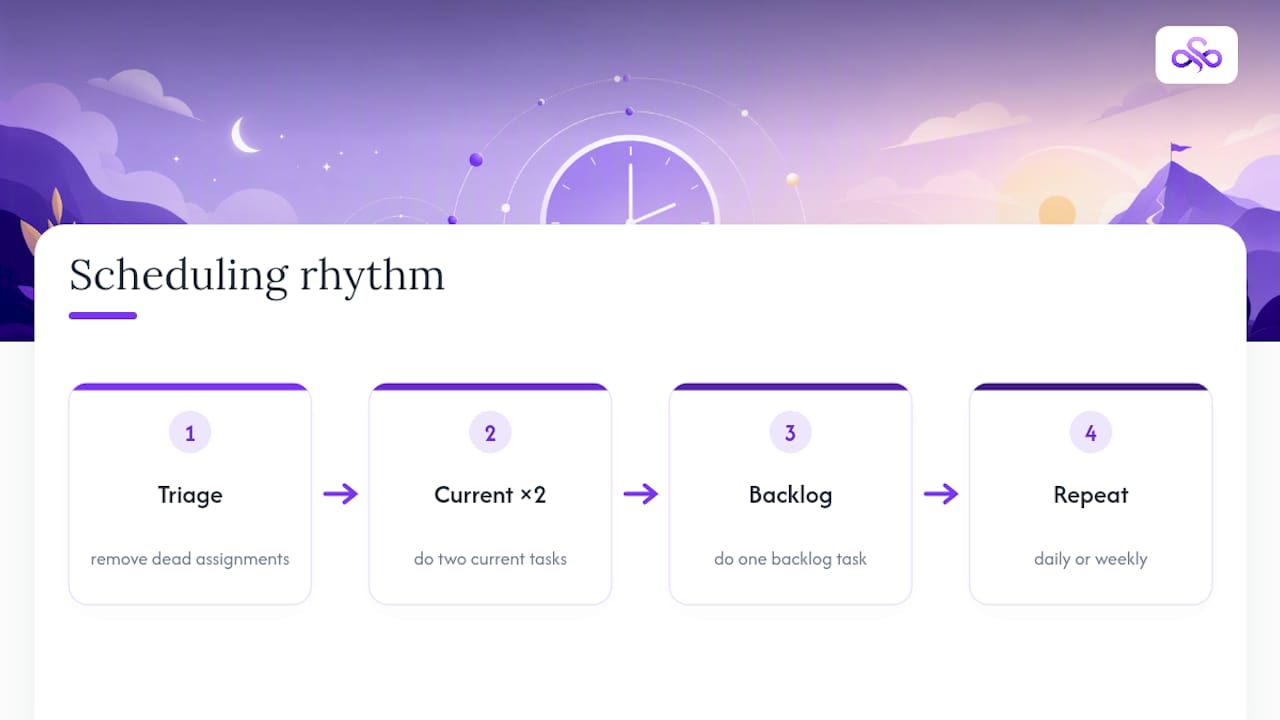
The harder problem is preventing new backlog while you dig out of the old one. This is where the 2:1 recovery rule earns its place: for every two current assignments you complete, schedule one overdue backlog item. Practitioners recommend this ratio specifically for students who are three or more assignments behind, because it keeps today's classwork from sliding into tomorrow's backlog while still forcing steady progress on the pile.
A concrete week might look like this:
- Monday: finish tomorrow's reading response (current), then finish tomorrow's problem set (current), then knock out one overdue lab report (backlog).
- Wednesday: current discussion post, current quiz prep, one overdue essay outline.
- Friday: current assignment, current assignment, one overdue project draft.
- Weekend: a longer deep-focus block dedicated entirely to whichever backlog item carries the most points.
Plan backwards from each deadline. If an essay is due in nine days and will take roughly six hours, block three two-hour sessions rather than one six-hour marathon the night before, since fatigue makes late sessions far less productive per hour.
Pro Tip: When your energy is low, schedule the low-stakes backlog items, formatting fixes, short quizzes, quick worksheets, into short windows to build momentum. Save your sharpest hours for the assignments that actually move your grade.
What's the Best Way to Actually Finish the Work?
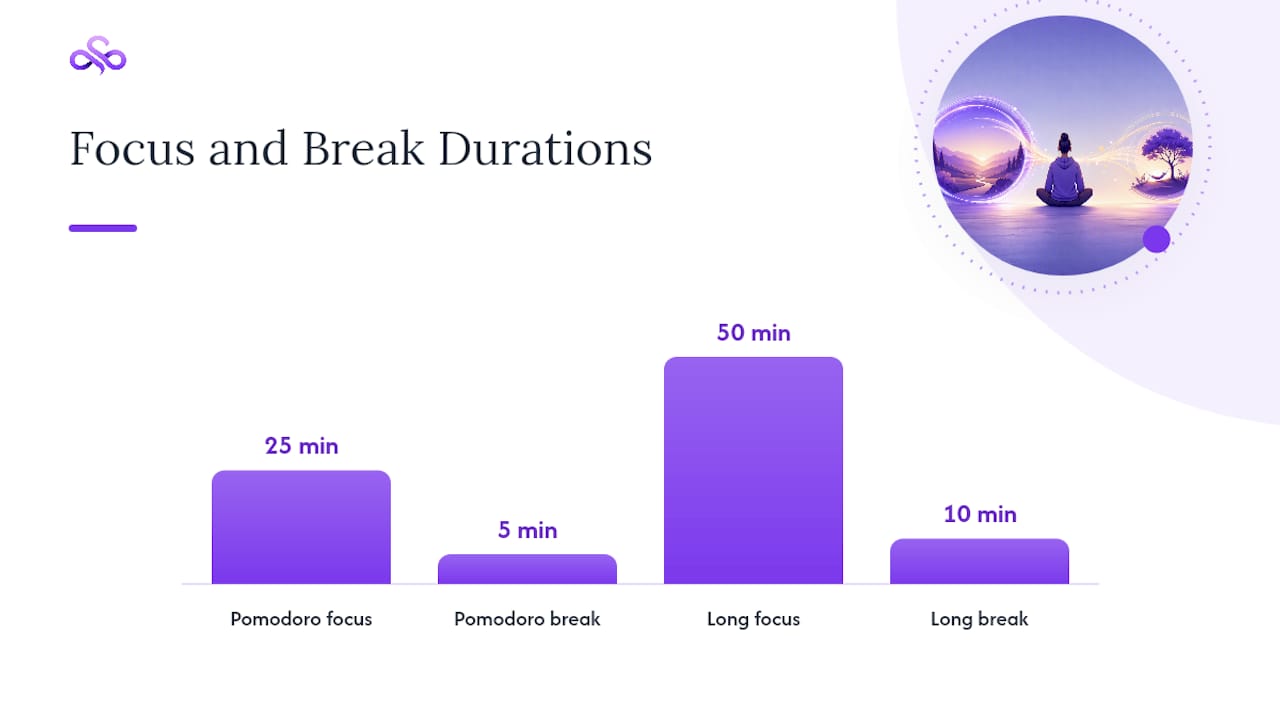
Timeboxing beats open-ended "work on it until done" sessions, because a ticking clock forces you to make decisions instead of drifting. The classic Pomodoro format runs 25 minutes of focused work followed by a 5-minute break, and it fits short tasks like discussion posts or problem sets well. For denser work, essays, lab reports, research summaries, switch to 50 minutes on and 10 minutes off; the longer stretch gives you room to get into a writing rhythm without breaking your concentration every half hour.
Big assignments stall people because "write the essay" is not a task, it's a category. Break it into sequenced microtasks instead: outline, rough draft, revision pass, proofread, submit. Each microtask has a clear finish line, which makes starting far less intimidating than staring at a blank document titled "Final Paper."
Give yourself permission to hit a "good enough" bar on lower-stakes backlog items rather than polishing them to perfection. Academic coaches note that limiting the visible size of your task list and setting small, achievable microgoals reduces the paralysis that keeps students staring at their to-do list instead of working through it. Task decomposition combined with focused blocks measurably increases how much work actually gets submitted rather than just planned.
Before you submit anything written under time pressure, run a fast quality pass. A proofreading checklist built for last-minute essays catches the errors that cost points even when the content is solid.
- Screenshot the confirmation page immediately after every submission.
- Save or forward the email receipt if your LMS sends one.
- Note the exact submission timestamp somewhere outside the LMS, in case the system glitches later.
How Do You Ask a Professor for a Late Extension?
Email the instructor before you submit, not after, whenever possible. A short, direct message works better than an apologetic essay:
"I'm behind on [assignment name], originally due [date]. I take responsibility for the delay. Would you accept it if I submit by [realistic new date]? I want to confirm before I finalize my plan."
That's it. Instructors respond faster to a specific proposed date than to an open-ended "can I get an extension," because it gives them something concrete to approve or counter.
- Request an extension when the grading policy allows late work with a penalty, or when you have a legitimate reason (illness, family emergency) documented.
- Submit anyway, without asking, when the syllabus states a hard zero for late work past a certain point. Asking just delays a submission that should already be in.
- Reply to confirm once you hear back, in writing, so there's a paper trail if the grade is disputed later.
Log every confirmation in one place, a note, a spreadsheet, a due date tracker. A privacy-first due date tracking setup keeps these confirmations and reminders in one spot instead of scattered across a dozen email threads.
When Should You Use Campus Support Resources?
Writing centers, subject tutors, and study groups exist specifically for weeks like the one you're having, and most U.S. colleges and universities offer them at no extra cost. A single 30 to 60 minute session with a writing center or tutor can shave hours off a complex paper or problem set, simply because a second person spots the gap you've been circling for an hour on your own, based on guidance from the U.S. Department of Education's Office of Elementary and Secondary Education.
To get real value from that session, arrive with a specific question, not a vague "can you look at this." Bring a draft, a problem set attempt, or a rough outline, and name exactly where you're stuck.
- Writing centers: thesis clarity, structure, citation formatting.
- Subject tutors: specific problem types you keep missing, not general review.
- Study groups: comparing notes on assignments with ambiguous instructions.
- Disability services or counseling: recurring absences, health issues, or chronic overwhelm driving the backlog.
Pro Tip: If your backlog traces back to repeated absences rather than one bad week, that's worth a conversation with disability services or a counselor, not just a scheduling fix. Attendance and engagement data tracked by the National Center for Education Statistics supports treating chronic absence as a signal to seek formal support, not just tighter time management.
Does the 2:1 Scheduling Rule Actually Work?
That single insight explains why so many backlog attempts fail. Students try to devote an entire weekend to old work, feel good about the dent they made, and then discover Monday's new assignments have already rebuilt the pile they just cleared.
The 2:1 ratio works because it treats the backlog as a permanent line item in your weekly schedule rather than a one-time emergency project. Two current tasks, one backlog task, repeated daily, produces steady forward motion on both fronts at once. Triage supports this by shrinking the pile before scheduling even starts, since removing dead assignments immediately often eliminates a meaningful chunk of what looked like an impossible list.
A Note From Syncronos
If you're staring at a backlog right now, you're not the exception. Nearly every student hits a stretch where deadlines pile up faster than energy allows, and the way out is rarely dramatic: a real list, a fair ratio between old and new work, and a few honest emails. Start with the Big List today. The rest of the plan only works once that exists.
— Syncronos
Let Software Build Your Big List for You
Building the Big List by hand across five classes, three learning platforms, and a dozen email threads is exactly the kind of manual work that eats the time you don't have. Syncronos reads your uploaded syllabi, checklists, and to-do lists directly and turns them into a single organized calendar, so the inventory step that normally takes an hour of digging takes minutes.
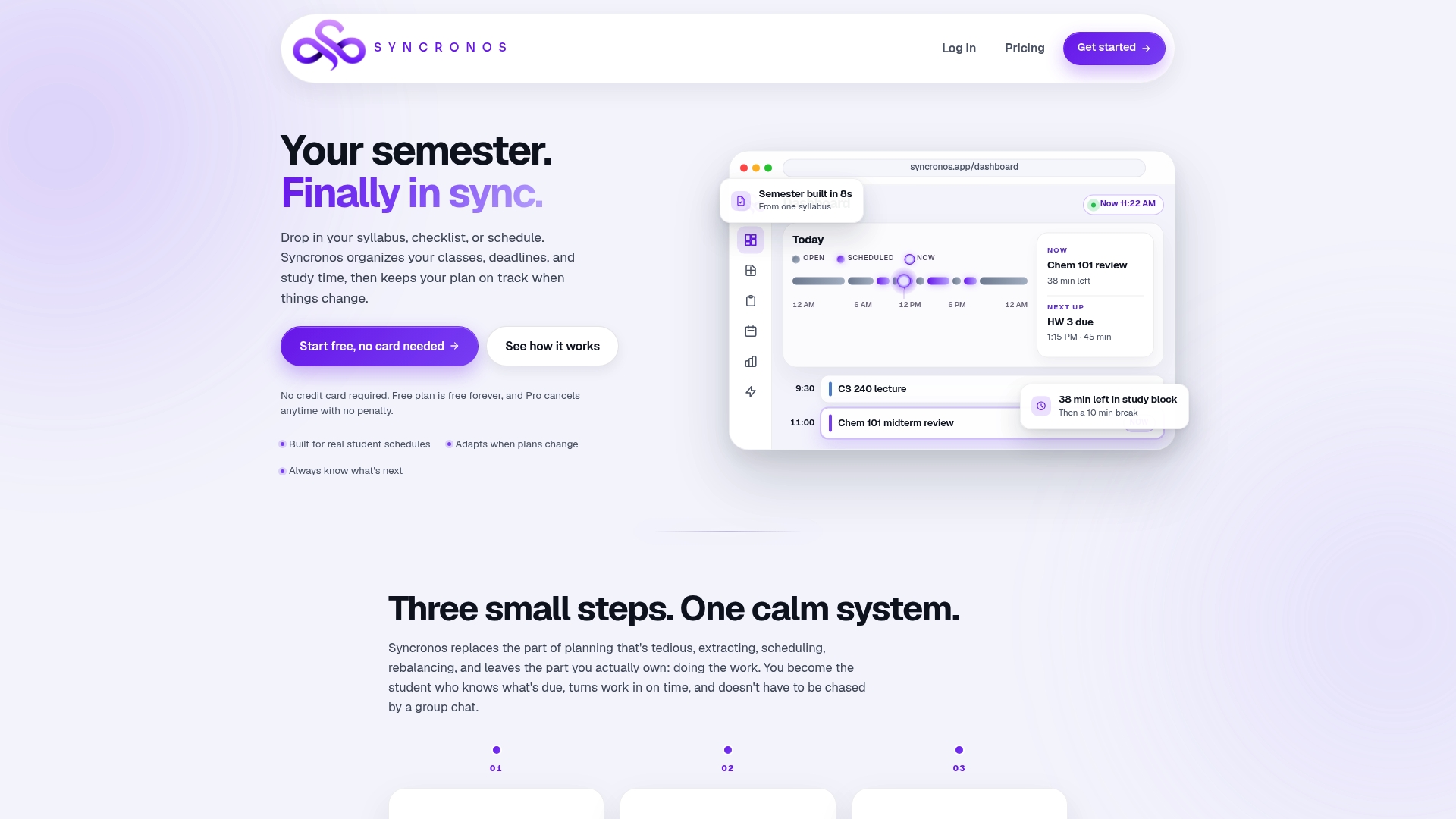
During an actual recovery week, that means you can generate your full list of current and overdue work in one pass, then let the AI study planner apply a 2:1 style balance between new assignments and backlog blocks automatically. When a due date shifts or a professor grants an extension, the schedule rebalances on its own instead of leaving you to redo the math by hand. The syllabus-to-calendar extraction handles the tedious first step; the dashboard handles prioritization from there.
Try the free tier and build your assignment planner around the plan in this article, starting with this week's actual deadlines.
Sources
The triage checklist in this guide draws on Riveta Labs' breakdown of missing-assignment order, while the week-by-week recovery structure follows UVic's academic recovery framework. Campus support recommendations reference the U.S. Department of Education's resource guidance, and the case for formal support when absences drive backlogs comes from NCES attendance data.
- Riveta Labs — I Have So Many Missing Assignments: The Order to Do Them
- UVic Learn — Never too late to get caught up
- NCES attendance data
FAQ
What Is the 10-Minute Rule for Homework?
It's a simple guideline suggesting students spend about 10 minutes of homework time per grade level per night, though during a catch-up period, the more useful version is committing to just 10 minutes on a dreaded task to break through avoidance and get moving.
What Are Signs of Overstudying During a Catch-Up Push?
Diminishing focus, declining accuracy on tasks you'd normally get right, and rising irritability or dread before sitting down are common signs; when they appear, a short break or a switch to a lower-stakes task usually restores output faster than pushing through.
What Is the Best Way to Keep Track of Assignments in College?
A single centralized list that pulls from your LMS, syllabi, and email works best, and tools like Syncronos automate that step by extracting deadlines directly from uploaded course materials into one adaptive calendar.
What Is the Hardest Year in College?
Most students report the first year and the final year as the toughest, the first for adjusting to unfamiliar workload and independence, the last for compounding deadlines across capstone projects, applications, and coursework at once.
How Do I Catch Up on a Large Backlog Without Burning Out?
Use the 2:1 ratio, pair every two current assignments with one backlog task, and lean on campus resources like writing centers or tutors for the assignments eating the most time.