
The fastest way to balance school and extracurriculars is to audit your real weekly hours, keep just 1 to 3 core activities, time-block academics before anything else, and protect at least 8 hours of sleep and one free evening a week. Cut or renegotiate anything left over. A tool like Syncronos can automate the audit and rebalance your schedule when plans shift. The sections below walk through each step.
TL;DR:
- Prioritize 1 to 3 core activities per term and eliminate or pause others to free up time for essential study and sleep.
- Track every hour in detail for at least one full week to overcome the planning fallacy and create an accurate schedule.
- Build your weekly plan starting with fixed commitments, then schedule study sessions during peak energy times and add buffers for flexibility.
- Drop activities that are low in goal relevance and enjoyment, and communicate specific requests when needing temporary schedule adjustments.
- Use automation tools like Syncronos to keep your schedule updated and balanced amid shifting commitments and deadlines.
Table of Contents
- An At-a-Glance Checklist You Can Use This Week
- How to Audit Your Time and Build a Realistic Weekly Map
- How to Choose What to Keep, Pause, or Drop
- Time-Blocking, Pomodoro, and Using Small Pockets of Time
- High-Impact Study Habits for Busy Students
- Protecting Sleep and Self-Care as Nonnegotiables
- How to Ask for Help, Trade Time, or Get Temporary Relief
- Adapting Your Commitments Across the School Year
- What Rebalancing Actually Looks Like
- Let Syncronos Handle the Schedule Logistics
- Sources
- FAQ
An At-a-Glance Checklist You Can Use This Week
Start this week with a fast reset rather than a full overhaul.
- Track every hour: classes, homework, commute, activities, work, and sleep.
- Pick 1 to 3 core activities for this term; mark the rest optional or on hold.
- Time-block study sessions around your class schedule, and protect 8 or more hours of sleep nightly.
- Flag upcoming conflicts early, and build 15 to 30 minute buffers between commitments.
Pro Tip: Write your weekly hours on paper before you touch a planning app. Seeing the total in ink, not just in your head, is usually what convinces a student to actually cut something.
How to Audit Your Time and Build a Realistic Weekly Map
Most students underestimate how long tasks actually take, a pattern researchers call the planning fallacy. The fix isn't better guessing. It's tracking a real week and using that data going forward.
- Log seven full days. Write down class time, commute, homework, activity practice or meetings, and sleep, hour by hour.
- Estimate study time per course. A common rule is two to three hours of study per hour of class contact, then add a 20 to 30 percent buffer since almost every task runs long.
- Review every Sunday. Spend 10 to 15 minutes moving flexible items and confirming fixed ones. Harvard's student time-management guidance points to weekly planning and time-blocking as core habits for managing a busy schedule.
How to Choose What to Keep, Pause, or Drop
Run each commitment through two questions: does it serve a real goal, and do you actually enjoy it? Activities that score high on both stay. Activities that score low on both go. Anything in between gets a temporary pause while you watch how the term unfolds.
- Keep: high goal value and high enjoyment (varsity soccer if you're aiming for a scholarship and love the sport).
- Pause: high enjoyment, low goal value right now (a club you love but that's not connected to your plans this term).
- Drop: low on both (an activity you joined for résumé padding and don't even like).
Depth matters more than breadth here. Colleges and employers tend to value sustained leadership in a few activities over a long list of shallow ones.
Pro Tip: When you need to step back, try: "I want to stay committed to the team, but I need to shift to a reduced role through midterms. Can we talk about what that could look like?" Coaches and supervisors respond far better to a specific ask than to a vague apology.
Time-Blocking, Pomodoro, and Using Small Pockets of Time
Build your week in this order, not randomly:
- Block fixed commitments first: classes, work shifts, practice.
- Schedule your priority study sessions next, while your energy is still fresh.
- Slot in extracurriculars around those blocks.
- Add 15 to 30 minute buffers between everything.
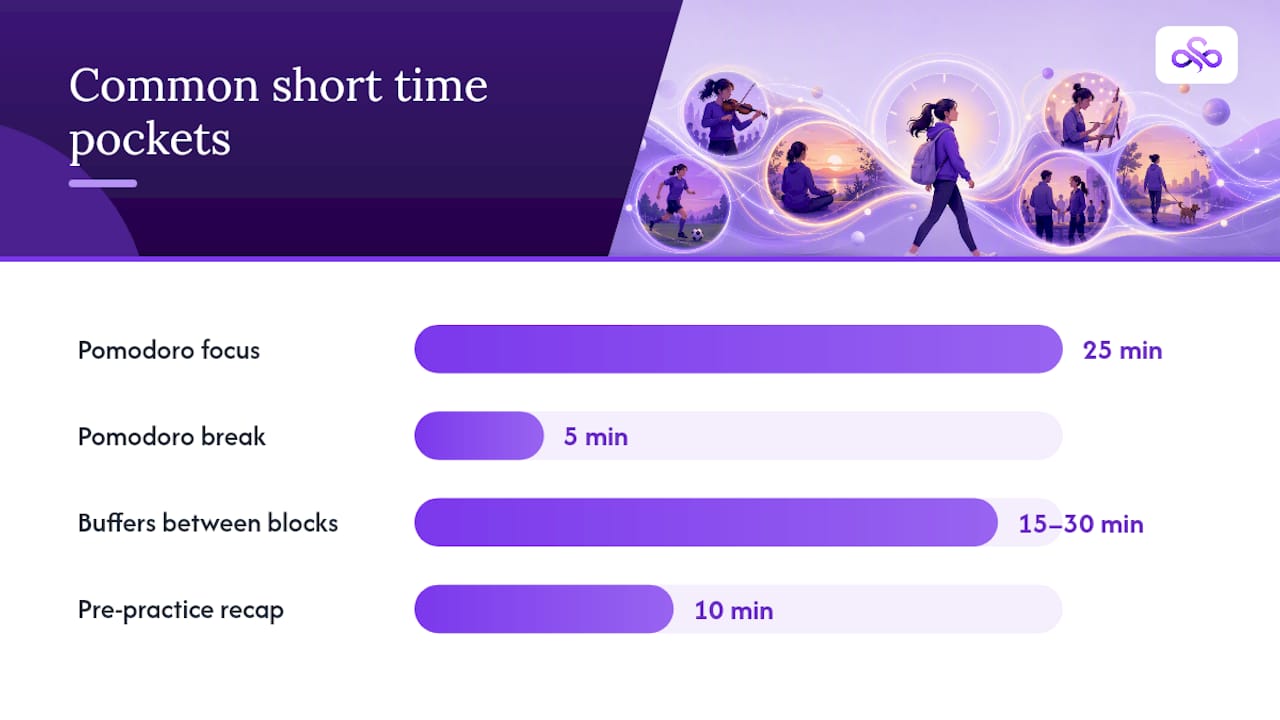
Inside your study blocks, the Pomodoro method (25 minutes of focused work, then a 5 minute break) keeps attention sharp during longer homework sessions. Short bursts also beat marathon cramming: research on the Youth Risk Behavior Survey found a large majority of high schoolers and middle schoolers reported short sleep on school nights, a pattern strongly tied to late-night, low-efficiency study sessions.
Don't waste dead time either. Commute minutes work well for flashcard review, and the ten minutes before practice starts can cover a quick reading recap. Batch similar small tasks (email replies, flashcard sets) instead of switching between different types of work every few minutes.
High-Impact Study Habits for Busy Students
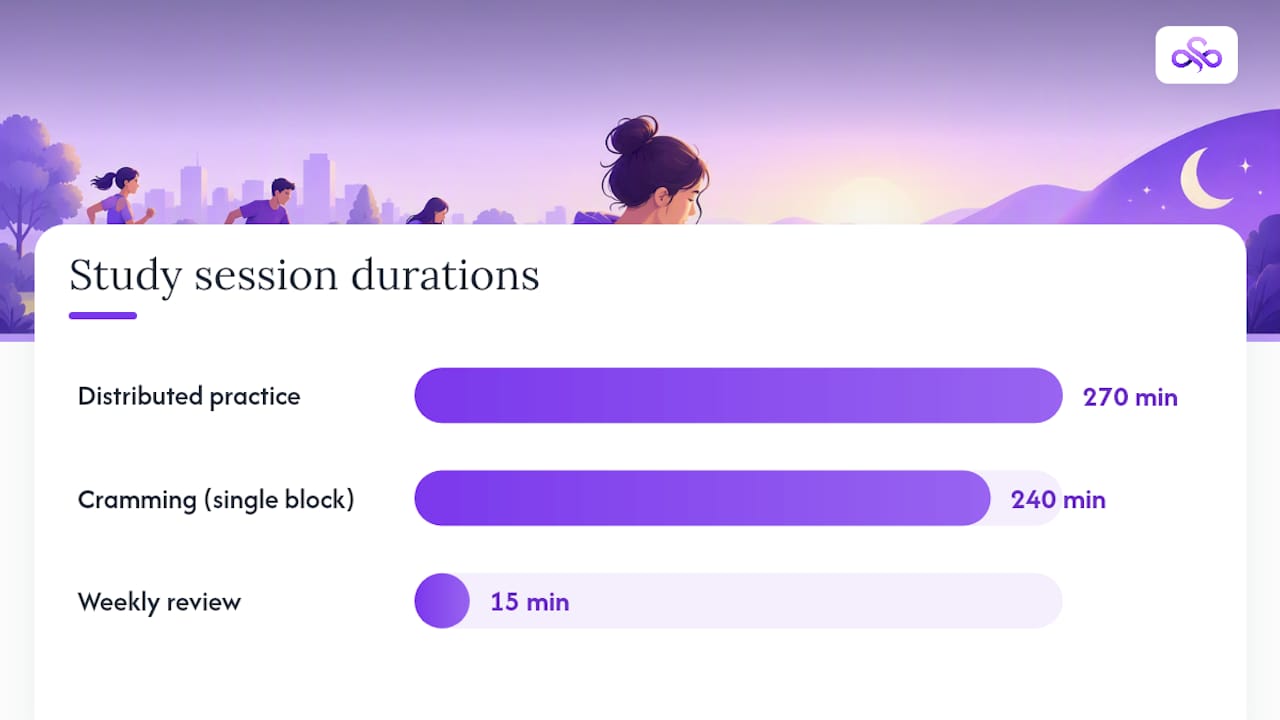
Cramming feels productive, but it isn't. Distributed practice outperforms massed practice for long-term retention, which means three 90-minute study sessions across a week beat one exhausting 4-hour block the night before a test.
Pair spacing with implementation intentions, meaning you decide the exact when, where, and how of a task instead of a vague goal like "study more." Writing "I will review biology flashcards at 4:00 PM in the library after practice" makes the task far more likely to happen than "I'll study biology sometime today." Close each week with a 15 minute review session that pulls together everything you covered, since that final pass is what locks material into long-term memory.
Protecting Sleep and Self-Care as Nonnegotiables
Sleep isn't a reward for finishing your to-do list. It's the thing that makes the rest of your schedule work. Students sleeping less than 7 hours a night report more difficulty completing schoolwork and weaker academic performance overall, which makes a full night's sleep one of the highest-leverage things you control.
The CDC recommends a consistent bedtime and limiting screens in the evening, both of which are easy to schedule into your weekly map. Reserve at least one evening a week with nothing planned. No homework, no practice, no obligations.
Watch for these burnout signs:
- Dreading activities you used to enjoy.
- Falling grades despite putting in more hours.
- Constant exhaustion even after a full night's sleep.
If two or more show up, pause a commitment immediately, talk to a school counselor, and give yourself a short, real rest period before deciding what comes back.
How to Ask for Help, Trade Time, or Get Temporary Relief
Notify a teacher or coach the moment you know a conflict is coming, not the week it happens. Give them the date, the reason, and a proposed solution rather than just a problem.
- For a graded assignment conflict: ask directly for a makeup date or an extension, and offer to submit early if that's easier for the teacher.
- For an activity conflict: propose a temporary reduced role, like sitting out one practice a week during exams instead of quitting outright.
- When talks stall: loop in a school counselor or academic adviser. They can mediate and often carry more weight with staff than a student negotiating alone.
Adapting Your Commitments Across the School Year
Treat the calendar as a cycle, not a fixed load. Use summer to explore new activities with less academic pressure, then narrow down to 1 or 2 core commitments once fall classes start. Scale back activity hours in the two weeks before finals or major exams, and build that pullback into your plan in advance instead of scrambling when the stress hits.
If you're aiming for a leadership role in a club or team, sustained multi-year involvement matters more than jumping between activities. Depth compounds; breadth resets to zero every time you switch.
What Rebalancing Actually Looks Like
One high school junior tracked her hours for a week and found she was spending 11 hours on a debate club she'd stopped enjoying. She dropped it, moved those hours into two extra study blocks for chemistry, and reset her bedtime to 10:30 PM. Within three weeks her sleep, focus, and chemistry grade had all noticeably improved.
— Syncronos
Let Syncronos Handle the Schedule Logistics
Once you know the plan, the tedious part is keeping it updated every time a practice moves or a deadline shifts. Syncronos automates that by pulling deadlines straight from your uploaded syllabi and to-do lists, building them into a calendar, and rebalancing your study blocks automatically when something changes.
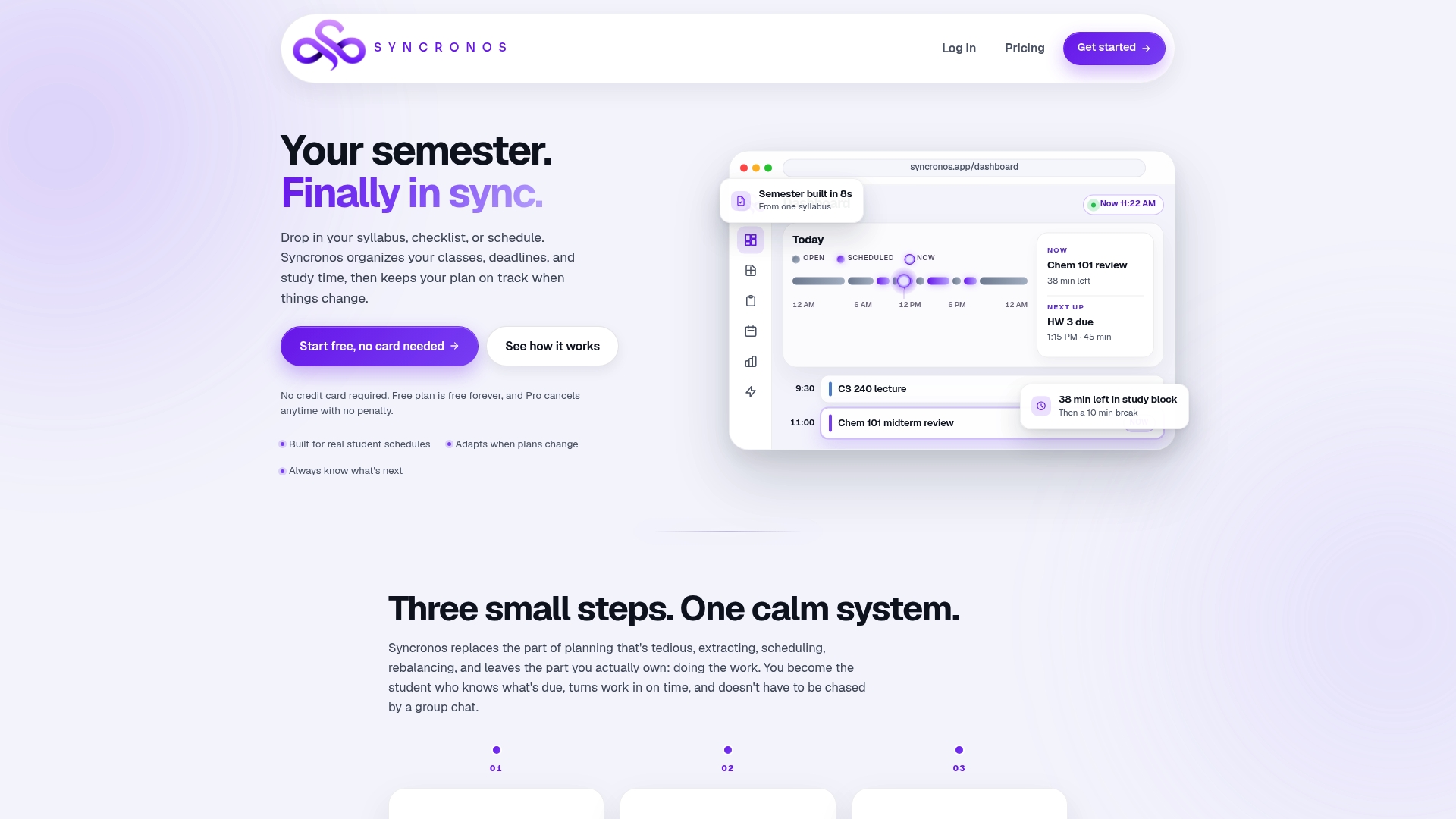
It's especially useful at three moments: the start of a new semester when you're loading in multiple syllabi at once, the week before exams when your study blocks need to expand fast, and any stretch where activities, work, and coursework are all shifting at the same time. The syllabus-to-calendar feature handles the initial import, while the AI study planner adjusts your blocks as deadlines move, so you're not manually rebuilding your week every time practice runs long.
Syncronos offers free and paid subscription plans with details available on their pricing page. Compare what each tier unlocks on the pricing page and set up your first semester map today.
Sources
- Prevalence of short sleep duration among middle school and high school students — PubMed
- Association of sleep duration and academic outcomes — PMC
- Sleep hygiene tips — CDC
- 8 time-management tips for students — Harvard Summer School blog
- Distributed practice and spacing — Duke Academic Resource Center
FAQ
What matters more, GPA or extracurriculars?
Neither wins outright. Colleges and employers generally look for solid grades paired with sustained depth in a few activities rather than a high GPA alone or a long list of shallow commitments.
What are the five main types of extracurricular activities?
Extracurriculars generally fall into five categories: athletics, academic clubs (debate, robotics, math league), arts and performance, community service or volunteering, and part-time work or entrepreneurship. Most students benefit from picking a mix rather than piling into just one category.
How do you balance studies and fun without falling behind?
Time-block your priority study sessions first, then build activities and social time around those fixed blocks rather than squeezing study time in around your social life. A planning tool like Syncronos can automate that rebalancing when your week changes unexpectedly.
What are the benefits of extracurricular activities?
Extracurriculars build skills outside the classroom: leadership, time management, teamwork, and a sense of belonging that supports emotional well-being. Research on student engagement links this kind of involvement to both stronger achievement and better overall well-being, though the effect depends on the activity fitting the student rather than adding pure overload.
How many extracurricular activities should a student have at once?
Most guidance points to 1 to 3 core activities per term, chosen for genuine interest and long-term goals rather than résumé volume. Adding more than that tends to thin out sleep, study time, and the depth colleges and employers actually notice.