

Start with the credit-hour rule: multiply your credits by 3 to get total weekly academic hours, then subtract your scheduled class time to find your out-of-class study target. Adjust that number up or down based on how hard each course actually is for you. Once you have a weekly total, convert it into calendar blocks and log your actual time for one to two weeks before trusting the plan.
TL;DR:
- Students should use their credit hours multiplied by three to estimate total weekly hours and subtract scheduled class time to determine out-of-class study needs.
- Adjustments for course difficulty using a multiplier between one and three are crucial to accurately reflect study effort for challenging courses.
- Task-based estimates are useful for heavy reading or writing assignments, with self-timing early in the semester improving accuracy.
- Effective planning includes spreading study sessions across the week and regularly reviewing progress to adjust estimates and priorities.
- Study schedules are most reliable when supported by adaptive tools that automatically update plans as deadlines shift and priorities change.
Table of Contents
- How Do You Calculate Study Hours From Credits?
- Adjust for Course Difficulty With a Simple Multiplier
- When Should You Use Task-Based Time Estimates?
- Does Your Study Plan Actually Fit Your Week?
- How Do You Turn Weekly Hours Into a Study Schedule?
- Test Your Estimate After One or Two Weeks
- Operationalizing Your Estimate With Syncronos
- How Should You Estimate Hours for Group Projects?
- Which Study Environment Actually Saves You Time?
- How Do You Prioritize Study Tasks by Deadline?
- Practical Perspective: Iterate and Protect Your Wellbeing
- Try Syncronos to Schedule and Adapt Your Study Hours
- Sources
- FAQ
How Do You Calculate Study Hours From Credits?
The credit-hour framework is the standard that most colleges use to define academic workload, and it's the best starting point for any study-hours worksheet. It assumes roughly 1 hour of class time plus at least 2 hours of independent work for every credit, which puts total weekly academic effort at credits × 3.
A 15-credit semester then implies about 45 hours of combined class and study time per week. Here's how that breaks down for a typical full course load:
- 15 credits × 3 = 45 total academic hours per week
- Roughly 15 of those hours are scheduled class time
- The remaining 30 hours are your out-of-class study target
That subtraction step matters more than it looks. Students who skip it end up planning class time twice, once as "class" and once as "study," which inflates their weekly total and makes the schedule feel impossible before it even starts.
Adjust for Course Difficulty With a Simple Multiplier
Not every 3-credit class demands the same effort, so the credit-hour baseline needs a difficulty adjustment. A worksheet method from Utah State University applies a simple multiplier to weekly class hours: low difficulty = 1, medium = 2, high = 3 study hours per class hour.
Here's how to apply it across a sample course load:
- List each course and its weekly class hours (a 3-credit lecture is usually about 3 hours).
- Rate each course low, medium, or high based on your own comfort with the material.
- Multiply class hours by the matching number (1, 2, or 3).
- Add the results across all courses for your adjusted weekly study total.
A student with three 3-hour classes rated medium, medium, and high would get (3×2) + (3×2) + (3×3) = 21 study hours, not the flat 27 hours a pure credit-hour formula would suggest. Push a course into the "high" category when you're missing prerequisite knowledge, carrying a heavy STEM lab load, or facing a writing-intensive syllabus.
When Should You Use Task-Based Time Estimates?
Credit-hour math works as a baseline, but it breaks down once you hit a 40-page reading assignment or a term paper with three drafts. That's when task-based estimation earns its place: break the work into reading, writing, problem sets, and discussion posts, then time each type separately.
Pro Tip: Time yourself on one representative reading or writing task early in the semester. That single data point becomes a far more accurate predictor of your personal pace than any generic rate matrix.
Course workload estimators, like the one built by Rice University's Center for Teaching Excellence, assign research-informed ranges for reading pages per hour and writing hours per page, since density and purpose swing those numbers widely.
Apply task-based estimates when:
- A single reading or writing assignment eats a disproportionate share of your week
- You're unsure whether a credit-hour multiplier fits an unusually heavy course
- You want to sanity-check a difficulty rating against real assignment volume
Students who record their own reading and writing rates on one assignment tend to produce far more reliable estimates for similar tasks later in the term than students relying on generic averages alone.
Does Your Study Plan Actually Fit Your Week?
A weekly study total only matters if it fits inside your actual week. The 168-hour model forces that reality check by subtracting fixed commitments from your total hours available.
Run the math like this:
- Start at 168 hours
- Subtract sleep (roughly 49 to 56 hours at 7 to 8 hours nightly)
- Subtract work, commuting, meals, caregiving, and exercise
- Compare what's left to your adjusted study target
If a 30 hour study target only leaves you 22 available hours, the plan doesn't work as written. Your real options are dropping or reducing credits, cutting work hours where possible, or building in tutoring support so the same material takes less independent time.
How Do You Turn Weekly Hours Into a Study Schedule?
A weekly number is just a budget until you assign it to actual days. Distributed practice, spreading study sessions across the week instead of compressing them into one long block, produces more durable learning than cramming, so aim for shorter, frequent sessions per course.
- Split each course's weekly hours into 4 to 6 focused sessions rather than one long sitting.
- Reserve dedicated exam-prep blocks in the final one to two weeks before each test.
- Divide total exam-prep hours by the days remaining, using a study schedule calculator logic to pace review evenly.
- Mix passive review (rereading notes) with active retrieval (self-testing) and problem solving within each block.
Pro Tip: A 90-minute block built as 30 minutes review, 45 minutes active practice, and 15 minutes self-quiz beats 90 minutes of straight rereading almost every time.
Test Your Estimate After One or Two Weeks
Every estimate is a guess until you check it against reality. Log your focused study minutes per course for one to two weeks, then compare that number to your worksheet estimate.
- If a course consistently runs over its budget, raise its difficulty multiplier or add task-based hours for its heaviest assignment type.
- If a course consistently runs under, redistribute those freed hours to a course that's falling behind.
- Weight your adjustments toward outcomes, not just hours. Assignment grades and practice test scores tell you more than raw time logged, since revising per-course budgets after real feedback produces a far more personalized plan than sticking to the original math.
Operationalizing Your Estimate With Syncronos
Building a worksheet by hand works, but keeping it updated as deadlines shift is where most study plans quietly fall apart. Syncronos reads your uploaded syllabi and to-do lists, then extracts assignments and deadlines directly into a calendar of scheduled study blocks that mirror the worksheet math above.
When a class gets rescheduled or an assignment deadline moves, some planners rebalance the remaining blocks automatically instead of leaving you to redo the 168-hour capacity check by hand. That adaptive rebalancing lines up directly with the one to two week review habit this article recommends: log your time, see where the plan is off, and let the study schedule adjust around the new reality rather than starting from scratch.
How Should You Estimate Hours for Group Projects?
Group projects break the standard worksheet math because your hours depend on other people's pace, not just your own. The safest approach is to estimate your individual task hours separately from the coordination overhead the group itself requires.
Start by splitting the assignment into discrete pieces: research, drafting, editing, and integration. Estimate your personal time on your assigned piece using the same task-based method you'd use solo, reading pages per hour or writing hours per page. Then add a separate coordination budget on top.

Build in buffer time specifically for the integration phase, since that's where group projects most often run long. If your piece is done a week before the deadline but a teammate's isn't, you'll likely spend additional hours reviewing, editing, or covering gaps. Treat that buffer as a separate line item in your worksheet rather than folding it into your personal task estimate, so a slow teammate doesn't make your own time budget look wrong in hindsight.
Finally, revisit the group's collective pace after the first milestone. If the team is consistently behind schedule, raise the coordination multiplier for the rest of the project rather than assuming the next deadline will go more smoothly.
Which Study Environment Actually Saves You Time?
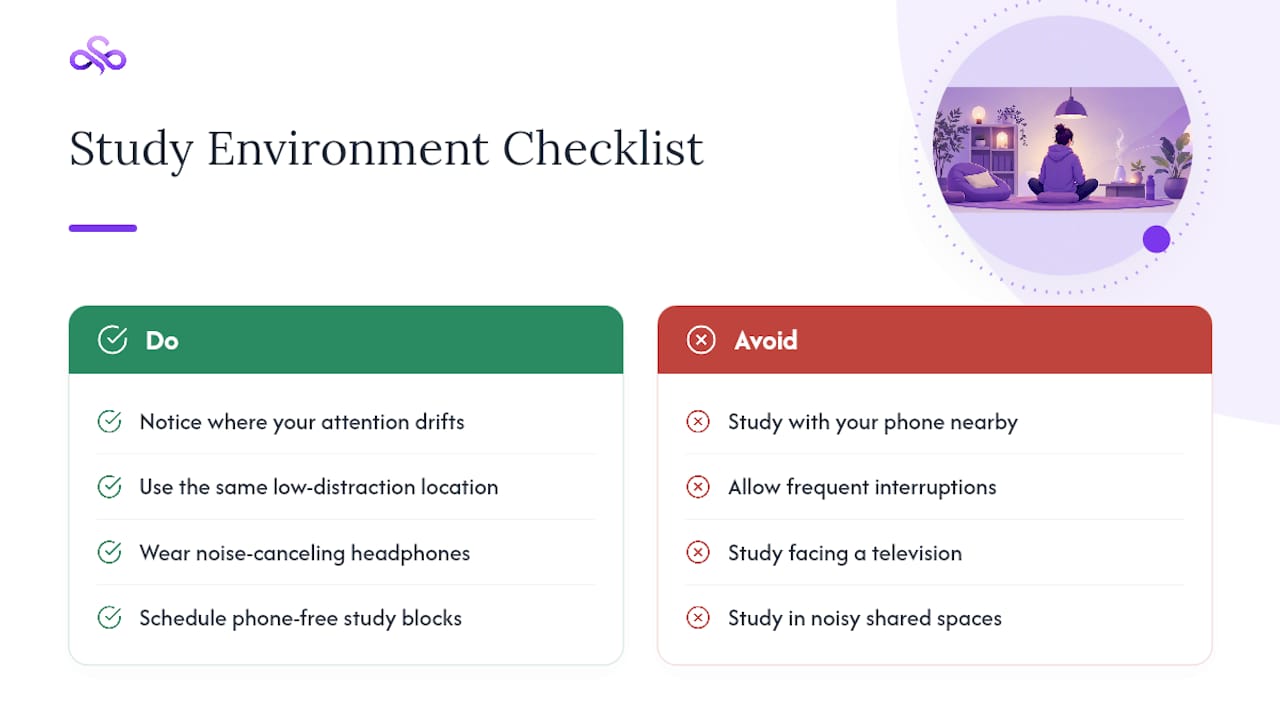
Where you study changes how many hours your estimate actually needs, because distraction directly inflates the gap between time spent and material learned. A student who studies for 2 hours with a phone nearby and frequent interruptions often retains less than a student who studies for 90 focused minutes in a quiet space, which means your worksheet hours only hold up if your environment supports actual focus.
Notice where your attention drifts before you build your weekly schedule. A shared apartment with constant noise, a library with unreliable seating, or a desk facing a television all create different efficiency losses, and no worksheet multiplier accounts for that variable directly. If you consistently find that your logged study time runs longer than your estimate for the same material, environment is often the hidden cause rather than course difficulty.
Practical fixes matter more than willpower here. Studying in the same low-distraction location each session builds a habit loop that reduces the mental startup cost of getting focused. Noise-canceling headphones, phone-free blocks, or simply switching from a bedroom to a library table can shrink a 2-hour session down closer to the 90 minutes your worksheet assumed. If your one to two week time log shows a persistent gap between planned and actual hours across multiple courses, check your environment before you assume your difficulty ratings are wrong.
How Do You Prioritize Study Tasks by Deadline?
A weekly hour total tells you how much to study, but not what to study first when three assignments and an exam all land in the same week. Deadline proximity should drive daily task order, with exam prep treated as its own category rather than folded into regular coursework.
Rank tasks using a simple two-factor system: how soon it's due, and how much prep time it realistically needs. A short quiz worth 5% due tomorrow still needs to happen before a term paper due in ten days, but that doesn't mean the term paper gets ignored. Block a small recurring slot for long-term projects even while short-term deadlines dominate your week, so a big assignment never gets crammed into its final 48 hours.
Exam dates deserve a countdown of their own. Once an exam is one to two weeks out, shift a portion of that course's regular study blocks into dedicated review and practice testing, using the exam-prep division method from the scheduling section above. Courses without an imminent deadline can absorb a smaller share of your week temporarily, as long as you rebalance once their own deadlines approach.
Practical Perspective: Iterate and Protect Your Wellbeing
Treat every number in this worksheet as a flexible budget, not a fixed contract. Test it for two weeks, watch what actually happens, and adjust without guilt. Individual pace varies enormously. What takes a classmate two hours might take you three, and that's information, not failure.
Protect sleep and recovery time even when the math says you need more hours. Consistent, focused sessions spread across the week reliably outperform occasional marathon cramming, both for grades and for how sustainable the semester feels by week twelve.
— Syncronos
Try Syncronos to Schedule and Adapt Your Study Hours
Building a worksheet by hand is a solid start, but keeping it current every time a deadline shifts is where most students give up. Some tools let you upload syllabi and to-do lists to extract deadlines and assignments automatically, then map your estimated study hours onto a real calendar instead of leaving that conversion to you.
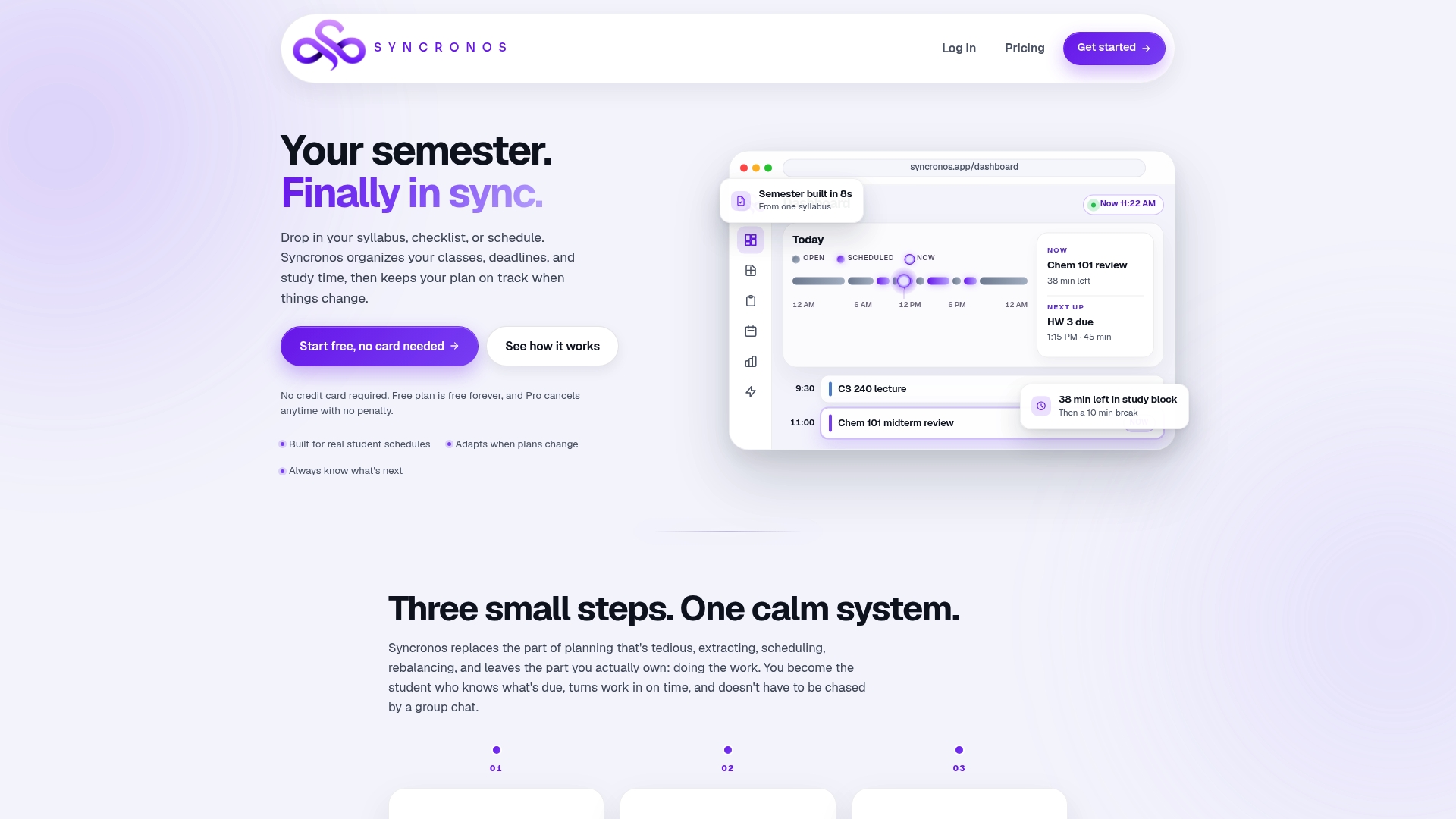
When a class gets rescheduled or a project deadline moves, some apps rebalance your remaining study blocks in real time rather than requiring a manual rebuild of your weekly plan. That adaptive rescheduling is what separates it from a static worksheet or spreadsheet. Users can get a prioritized view of what's due and when, without needing to recalculate their capacity check every time life shifts.
You can start with the Free plan to test how syllabus extraction and calendar mapping work for your current course load, or move to the Monthly plan at $8.99 per month or the Yearly plan at $55.99 per year for unlimited AI-optimized rescheduling and workload forecasting. Upload a syllabus today and see your semester mapped into study blocks within minutes.
Sources
- Credit hour standards: policies (Indiana University)
- Estimate Study Hours (Utah State University)
- Course workload estimator (Rice University Center for Teaching Excellence)
FAQ
How Do You Calculate Study Hours?
Multiply your total credits by 3 to get weekly academic hours, then subtract scheduled class time for your out-of-class study target, following the credit-hour standard. Adjust that baseline with a difficulty multiplier, then refine further with task-based estimates for heavy reading or writing assignments.
What Is the 1/3.5/7 Rule in Studying?
This isn't a standard academic workload framework, and definitions of it vary widely across student forums with no consistent source. Stick with the credit-hour baseline and a difficulty-adjusted worksheet instead, since both rest on documented institutional policy.
How Do You Calculate Work Study Hours?
Work-study hours are set by your award and employer schedule, not a credit formula, so check your financial aid award letter for your maximum weekly hours. Once you know that number, subtract it from your 168-hour capacity check alongside sleep and fixed commitments to see what's left for coursework.
Is Studying Four Hours a Day Every Day a Lot?
Four hours a day across a full course load sits within a typical range for a 15 credit semester under the credit-hour framework. Whether it feels like a lot depends on your course difficulty, work schedule, and other commitments, which is exactly what the 168-hour capacity check is designed to reveal.