

Your final exam time is set by your university registrar, based on your course's meeting pattern and start time, not by your instructor's guess or last year's syllabus. Confirm it now: open your registrar's official final exam schedule and your current course syllabus side by side, and flag any mismatch with your instructor or the registrar's office directly. A tool like Syncronos can pull meeting patterns straight from your syllabi and turn confirmed exam times into a study calendar automatically, but the registrar's table is always the source of truth.
TL;DR:
- Final exam times are officially determined by your university's registrar based on your class's meeting pattern and start time, not your instructor's preference.
- Always verify your exam schedule against the registrar's published tables and your course's official start time to avoid mismatches.
- Different class meeting patterns and start times require consulting separate registrar grids to prevent scheduling conflicts.
- Nonstandard finals, such as department-wide or instructor-arranged exams, often require direct communication with instructors and adherence to official conflict policies.
- Building a study plan should focus on active practice aligned with your exact exam times, with preparation starting at least a few days in advance for effective retention.
Table of Contents
- How Do You Find Your Official Finals Week Schedule?
- How Do Class Start Times Map to Exam Slots?
- What Counts as a Nonstandard Final, and How Do You Handle Conflicts?
- How Should You Build a Study Plan Around Your Exam Times?
- What Does a Realistic Finals-Week Timetable Look Like?
- Why Automating Your Syllabus Into a Calendar Matters at Finals Time
- Turn Your Confirmed Exam Times Into an Adaptive Study Calendar
- Where Should You Check Your Official Exam Times Right Now?
- Sources
How Do You Find Your Official Finals Week Schedule?
Your registrar's website is the only place with binding exam times. Most schools publish this under a page titled "Final Exam Schedule" or "Exam Week Information," usually linked from the registrar's homepage or the academic calendar. Iowa State University's registrar, for example, hosts a dedicated final exam schedule page that maps every class time slot to its exam window each semester.
Before you search the table, find your class's official "first meeting time" on your syllabus or in the course catalog listing, not the time you happen to remember walking in. That distinction trips up more students than any other part of this process, because a class that "feels like" it starts at 10:00 a.m. might officially list 9:30 a.m. in the registrar's system.
Once you have the exact start time and meeting days, work through this checklist:
- Locate the registrar's exam table for your semester and find the row matching your class's meeting pattern (MWF, TTh, etc.) and start time.
- Cross-check the date against the academic calendar to confirm it falls inside finals week.
- Note the listed duration and room. Some finals run longer than a standard class period.
- Check for a "common final" or "group final" flag, which overrides the standard table.
- If anything looks off, email your instructor first, then contact the registrar directly for written confirmation.
Washington's academic calendar makes the underlying logic explicit: the time of your final is determined by the first listed class meeting day and time in the official course schedule, not by convention or habit.
How Do Class Start Times Map to Exam Slots?
Registrars don't run one universal exam table. They typically publish separate grids for Monday/Wednesday/Friday classes, Tuesday/Thursday classes, once-a-week seminars, and night classes, because each meeting pattern needs its own logic to avoid double-booking students. The University of Kansas registrar structures its schedule exactly this way, with distinct tables so a 9:00 a.m. MWF class and a 9:30 a.m. TTh class don't collide into the same exam block.
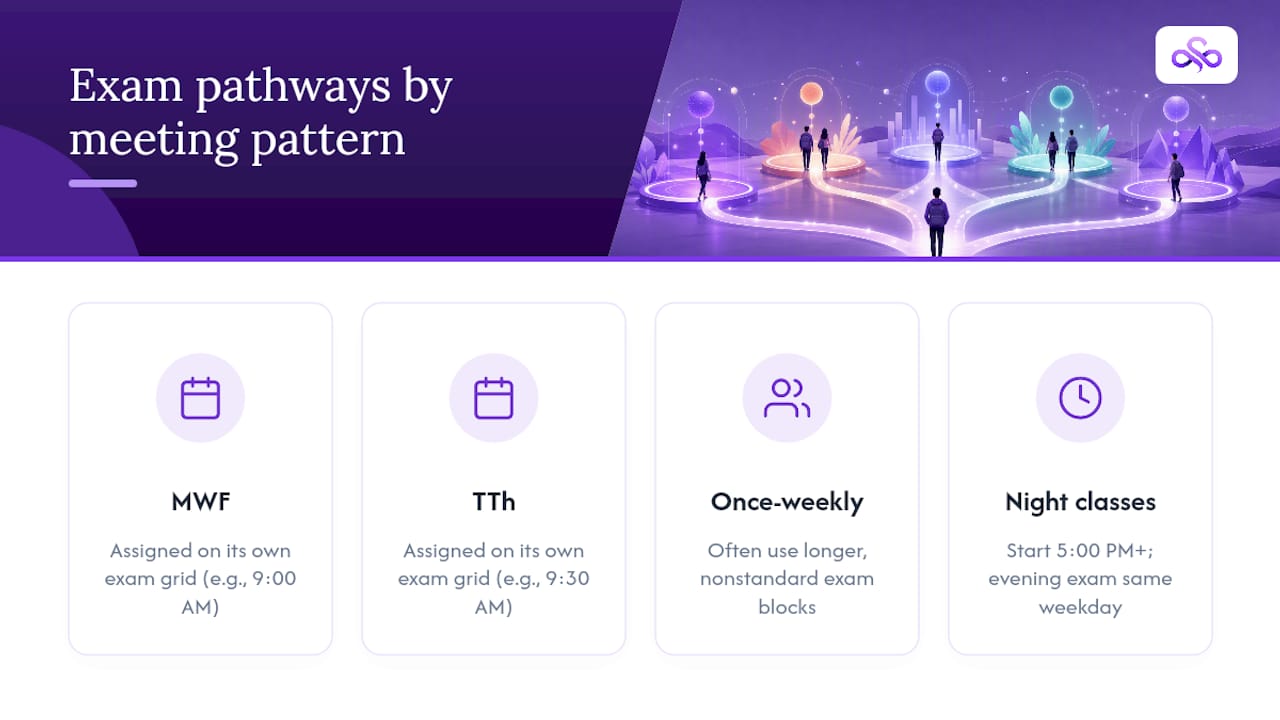
The table below shows a representative structure, similar to what most large public universities publish. Treat it as an illustration of the pattern, not your actual schedule. Always verify against your own registrar.
Night classes get their own logic almost everywhere. Kansas's registrar notes that any class starting at 5:00 p.m. or later usually falls into a separate night-class final schedule, held the same weekday in the evening rather than being squeezed into daytime slots. Most standard finals run two to three hours, but always check your specific row. Some once-weekly seminars and studio courses run longer blocks that don't fit the standard grid at all.
What Counts as a Nonstandard Final, and How Do You Handle Conflicts?
Not every exam follows the standard table. Nonstandard finals include instructor-announced alternate times, department-wide common finals, group finals for multi-section courses, and Saturday exams scheduled outside the normal week. Oregon State University's registrar confirms that common and group finals are scheduled separately from the standard grid, which means your syllabus, not the general table, is often the deciding document for these courses.
If you find two exams stacked in the same window, work through it in order:
- Recheck your syllabus. Some instructors already list a written policy for conflicts.
- Email your instructor immediately, referencing both exam times and asking for a resolution path.
- Follow your registrar's official conflict policy, which usually requires a documented request rather than a verbal one.
- Escalate to your department or dean's office if the instructor can't resolve it within a few days.
Keep every email time-stamped. Registrars frequently require written confirmation before they'll formally reschedule anything, and a verbal agreement with an instructor rarely holds up if the registrar's office gets involved later.
Pro Tip: Large lecture finals sometimes move to a gym or auditorium instead of your usual room. MIT's registrar guidance recommends verifying your exact room assignment a few days out and arriving early, since seating charts and ID checks in these overflow venues run stricter than a normal classroom.
How Should You Build a Study Plan Around Your Exam Times?
Once your exam times are locked, stop treating study time as one undifferentiated block. The Weingarten Center's finals-week guidance recommends spending roughly 30% of your remaining time on review and 70% on active practice, meaning timed problem sets, past exams, and recall drills rather than rereading notes. First exposure to new material during this window tends to backfire; if you haven't learned it yet, cramming it in the final 48 hours rarely sticks.
The 30/70 rule: Spend about 30% of your remaining prep time reviewing material you already know, and 70% actively practicing it under timed, test-like conditions.
Match your practice sessions to your actual exam time. If your economics final starts at 9:00 a.m., run a timed practice test at 9:00 a.m. two or three days beforehand, not at midnight the night before. This aligns your cognitive rhythm with test conditions instead of training your brain to perform at the wrong hour.
- Morning exams: schedule your hardest practice blocks for the same morning window all week.
- Evening exams: shift your whole study schedule later, including sleep, so you're alert when it counts.
- The night before: keep review light. Skim a summary sheet, don't open a new textbook chapter.
- Build in recovery blocks after each exam before starting the next subject's push.
What Does a Realistic Finals-Week Timetable Look Like?
Start prepping the week before finals actually begins. Confirm every exam time against the registrar, request any accommodations you need, and build a materials list for each course so you're not scrambling for a formula sheet at midnight.
- Five days out: Confirm all exam times, rooms, and durations against the registrar's table.
- Four days out: Build a master list of every exam's date, time, length, and required materials.
- Three to two days out: Run timed practice sessions matched to each exam's actual start time.
- The day before each exam: Light review only, plus a full night's sleep.
- Exam day: Arrive early, especially for common finals in unfamiliar rooms.
A basic daily template: morning block for active practice on your hardest subject, afternoon for a second course's practice set, a real lunch break, early evening for lighter review, and an hour buffer before bed with no screens. If you have back-to-back exams on the same day, protect a 30 to 60 minute reset between them. Don't try to cram the second exam's material during that gap.
Why Automating Your Syllabus Into a Calendar Matters at Finals Time
Syncronos reads your syllabi and pulls out meeting patterns and deadlines automatically, then anchors your study blocks to the exam times you've confirmed with your registrar. When a professor pushes a review session or the registrar posts a room change, the schedule rebalances around it instead of leaving you to redo the whole week by hand. That's the gap most planning apps ignore: finals week schedules change, and your study plan needs to move with them.
— Syncronos
Turn Your Confirmed Exam Times Into an Adaptive Study Calendar
Syncronos is the faster path from a registrar's exam table to a finished study week, built specifically for students who don't want to build a spreadsheet from scratch every December. Upload your syllabi, and the syllabus to calendar feature extracts your meeting patterns and deadlines directly, so you're not retyping exam dates by hand.
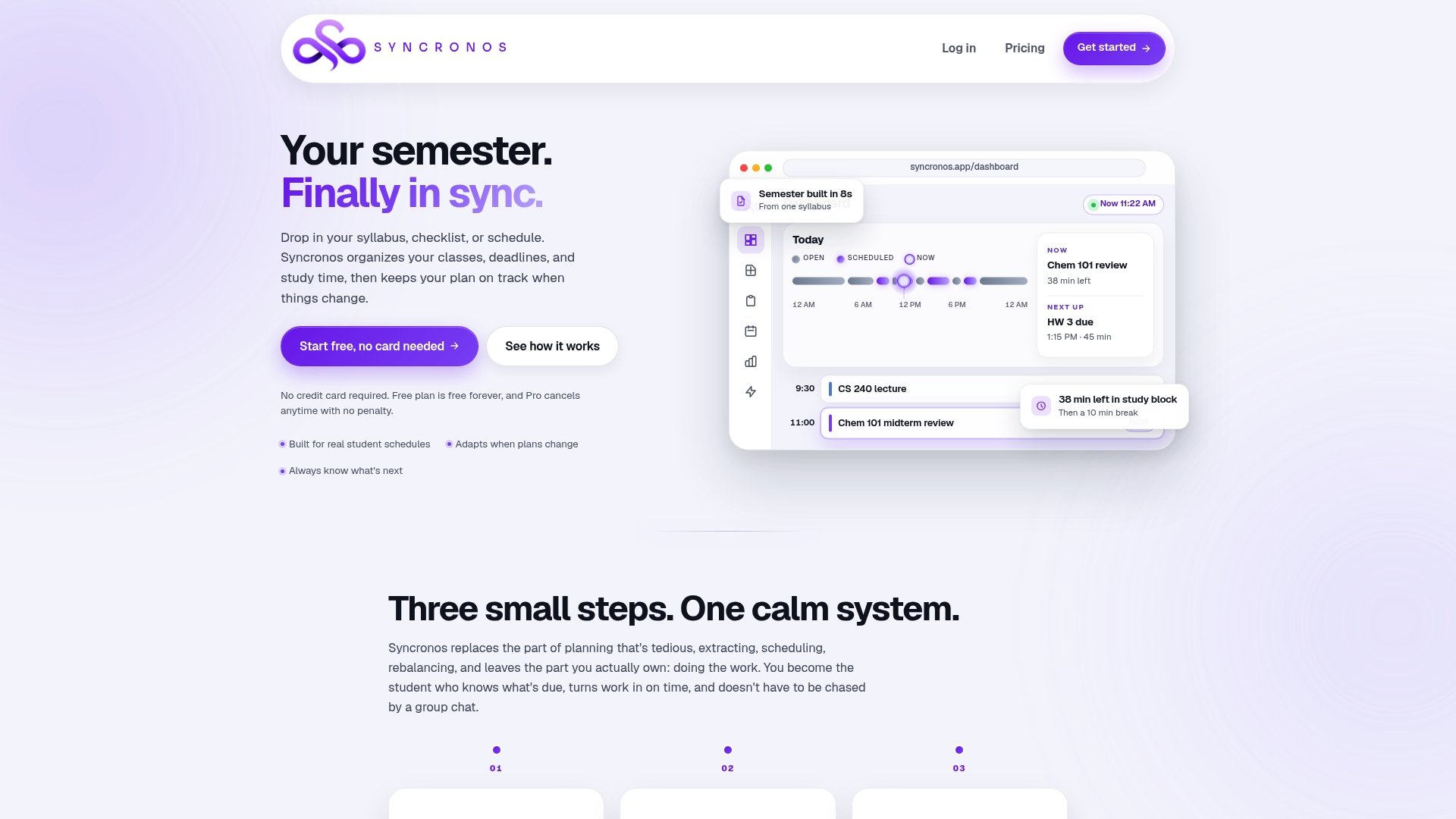
Once your official exam times are in, the exam study planner builds study blocks around each one, and if a professor moves a review session or your registrar shifts a room, the plan rebalances instead of falling apart. The free tier gets you manual scheduling and a limited number of AI-generated plans; the paid plan unlocks unlimited AI optimization, workload forecasting, and dynamic rebalancing across every exam on your calendar. Sign up free and generate your first finals-week plan, or check the pricing page to see what the Pro tier adds before your next exam block hits.
Where Should You Check Your Official Exam Times Right Now?
Start with your own registrar's final exam schedule page and academic calendar. These two pages, together with your syllabus, are the only sources that carry real weight if a conflict comes up later.
- Your university's registrar final exam schedule page, searchable by class meeting pattern and start time.
- Your school's official academic calendar, which lists finals week dates and exam-time rules.
- UNC's Learning Center final exam planning tools, which offer printable planners and checklists for organizing exam-week tasks.
- Semester Flow, another syllabus-to-schedule automation tool worth comparing if you want a second opinion on approach.
Sources
- Fall 2026 Final Exam Schedule | Office of the University Registrar
- Final exam schedule - Iowa State University
- Academic Calendar — Final Examination Week — December 14 - 18, 2026
- Weingarten Center — How to create a finals-week study plan