
Build a prioritized, day-blocked schedule now, ranking exams by date and grade weight rather than by which subject feels scariest. Pair active recall sessions with the Pomodoro technique, and leave short recovery and buffer blocks between them. A tool like Syncronos can turn your syllabi into that calendar automatically, but the underlying method matters more than any app you use to run it.
TL;DR:
- Prioritize exam dates and grade weight over subject difficulty when scheduling study blocks to maximize efficiency.
- Use a scoring system to rank courses by urgency, weight, and difficulty, then allocate study time proportionally.
- Incorporate active recall methods like self-testing and teach-back during focused sessions, avoiding passive rereading.
- Limit study hours to around six productive hours daily, with structured breaks, buffers, and wellness activities to maintain focus.
- Use adaptive scheduling tools to automatically update your plan as deadlines shift, freeing time for actual study instead of manual reorganization.
Table of Contents
- How Do You Build a Finals Week Study Schedule?
- Sample Schedules for Every Timeline
- How to Design a Study Session That Actually Works
- The 30/70 Rule for Splitting Your Time
- Your Last-Minute and Exam-Day Checklist
- Where Wellness Fits Inside a Study Schedule
- Why Sleep Deserves a Fixed Spot on Your Calendar
- Why Adaptive Scheduling Changes Finals Week
- Let Syncronos Build the Schedule While You Study
- Sources
How Do You Build a Finals Week Study Schedule?
Start by putting every deadline in one place. Most students carry exam dates in three or four different apps, syllabi, and half-remembered email threads, which is exactly how a paper gets forgotten until 48 hours before it's due.
Step 1: Map everything. List every final, project, and take-home exam with its date, format (multiple choice, essay, oral, lab), and weight toward your final grade. A stepwise approach like this, mapping exams, ranking urgency, then breaking work into tasks, is the model most university finals guides converge on.
Step 2: Rank your courses. A simple scoring method works better than gut instinct:
- Score each course 1 to 5 on how soon the exam lands.
- Score each course 1 to 5 on grade weight (a 40% final outranks a 10% quiz).
- Score each course 1 to 5 on personal difficulty.
- Add the three scores. Highest total gets first claim on your best hours.
Step 3: Break material into chunks. Don't write "study Biology" on your calendar. Write "complete 20 practice questions on cell respiration" or "outline chapters 4 through 6." Giving each block a measurable outcome makes it obvious whether the session succeeded, and it makes triage easier when you're running short on time two days out.
Step 4: Block the calendar with buffers. Cap yourself around 6 productive study hours a day. That's lower than the 10 to 12 hours students often aim for, and it's a far more realistic ceiling once you account for meals, commute, and the fact that focus drops sharply after hour five. Build in transition time between blocks, not just between subjects.
- Assign whole mornings or afternoons to one subject instead of chopping the day into 30-minute fragments.
- Protect at least one meal and one movement break per study day.
- Leave a 30-minute buffer before bed with no screens and no new material.
Review the next day's plan every night before you sleep. Ten minutes of adjusting for what you actually finished, versus what you planned, keeps the whole week from sliding off track.
Pro Tip: Assign each block a one-sentence success test before you start it, like "I can explain this concept out loud without notes." If you can't pass that test at the end, extend the block instead of moving on.
Sample Schedules for Every Timeline
The right template depends on how much runway you have and how many finals are stacked on top of each other.
The five-day plan works well when you're prepping for one or two exams. It splits each day between "preparation" (learning or relearning material) and "review" (testing yourself on it), with roughly two hours of focused work per day:
- Day 5: Gather materials, identify weak topics, prepare a study guide.
- Day 4: Prepare the hardest section first, review anything already covered.
- Day 3: Prepare remaining material, run a short self-test.
- Day 2: Full review pass, timed practice questions.
- Day 1: Light review only, sleep early.
The seven-day template suits heavier loads, three or more finals in one week. It adds an extra spaced review pass per subject and front-loads your toughest course into the first two days, when concentration is highest before fatigue sets in.
The 48-hour triage plan is for when finals week arrived faster than you did. Focus only on high-yield material: run one closed-book practice test, then spend the next block correcting only what you missed. Repeat that cycle two or three times per subject rather than rereading notes end to end.
For back-to-back exams, treat the earlier one as your hard deadline for new learning and shift the later exam into review-only mode 48 hours out, backed by a short emergency topic list you can scan in the hallway.
How to Design a Study Session That Actually Works
A two-hour block of rereading a textbook feels productive and teaches you almost nothing. Active recall, testing yourself instead of re-exposing yourself to the material, consistently outperforms passive rereading, and it takes a specific structure to work well.
- Flashcards for vocabulary, formulas, and discrete facts you need cold.
- Self-testing with old exams or practice questions, done closed-book.
- Teach-back, explaining a concept out loud to an empty room or a study partner, which exposes gaps rereading never will.
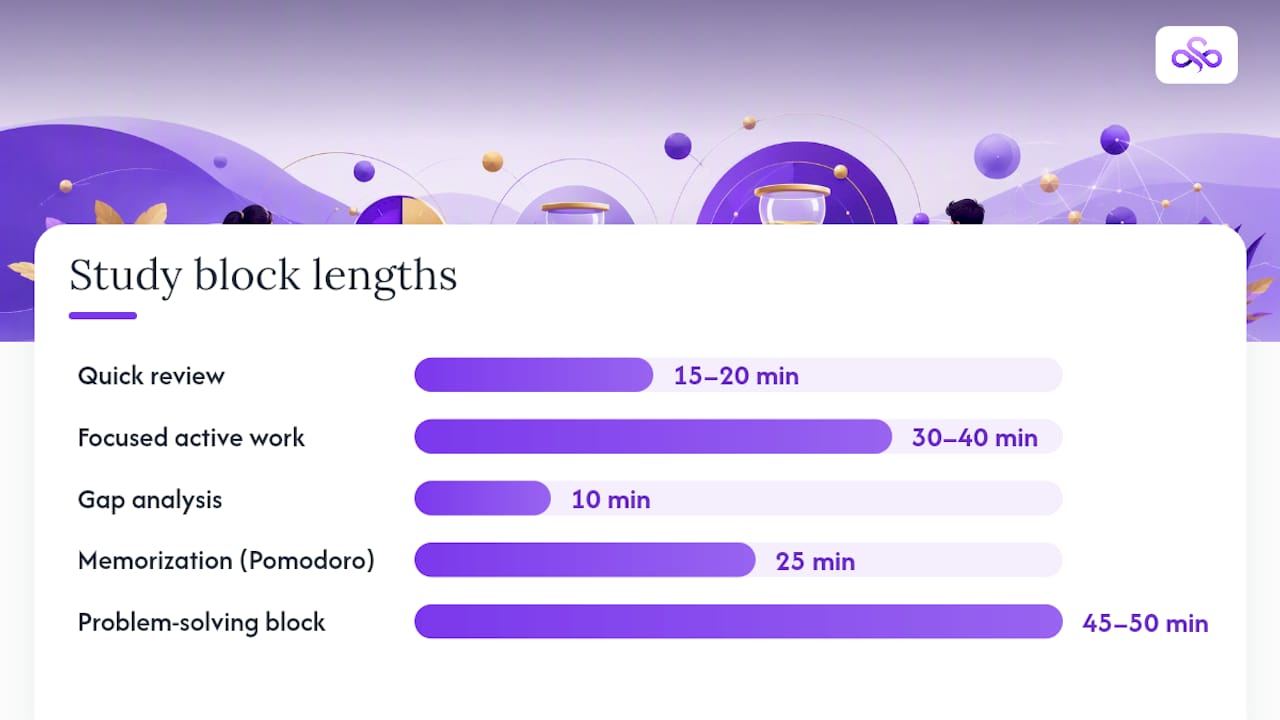
A reliable session formula: 15 to 20 minutes of quick review to reload the material, 30 to 40 minutes of focused active work (practice problems, flashcards, a timed quiz), then 10 minutes of gap analysis to note exactly what you missed and why.
Standard Pomodoro (25 minutes on, 5 off) fits memorization-heavy subjects. For problem-based courses like calculus or organic chemistry, stretch to 45 or 50 minute blocks so you don't get cut off mid-problem. Interleave related topics (mixing problem types within one session) for math and science; use blocked practice (one topic at a time) for dense reading-heavy material like history or literature.
Pro Tip: If a flashcard trips you up twice in one session, don't just keep flipping through the deck. Stop and write out the answer by hand once, then put that card back three cards later instead of at the end of the pile.
The 30/70 Rule for Splitting Your Time
A workable allocation is roughly 30% review and 70% active practice, a ratio used by university learning centers precisely because most students default to the opposite. Shift toward more review only for a course that's almost entirely conceptual with no problem sets to practice against.
- Convert your course ranking into hours: a top-ranked course with a 40% final might get 8 to 10 hours; a lower-ranked course with a 10% quiz might get 2.
- Cap total study time around 6 productive hours daily and treat anything beyond that as diminishing returns.
- After each exam, immediately reassign its hours to whatever final is next, and cut any task that isn't tied to a measurable outcome.
Your Last-Minute and Exam-Day Checklist
By 48 hours out, you should have run at least one timed practice test per subject and built a short emergency topic list for anything still shaky.
The night before:
- Stop learning new material entirely.
- Do one light review pass, flashcards or a skim of your outline.
- Sleep 6 to 8 hours. Sleep meaningfully improves memory consolidation, and an all-nighter the night before an exam almost always costs more than it gives back.
Exam day:
- Pack your ID, calculator, pens, and any allowed materials the night before.
- Arrive 10 to 15 minutes early, not 45. Excess waiting time breeds anxiety.
- Do a 5-minute warm-up: skim your one-page emergency sheet, nothing new.
- After the exam, take a genuine 20-minute reset (walk, food, silence) before opening the next subject's notes.
Where Wellness Fits Inside a Study Schedule
A schedule that ignores your body will fail regardless of how well it's organized. Breaks, movement, and mindfulness aren't extras you fit in if there's time. They're what makes the study blocks around them effective.
Build a 10-minute walk or stretch break into every two-hour stretch of studying. Physical movement resets attention in a way that scrolling your phone during a break does not, since screen breaks tend to keep the same shallow, reactive attention engaged instead of letting it recover. A five-minute breathing exercise before a high-stakes session can lower the physical edge of exam anxiety enough to think clearly once you sit down.

Schedule wellness the same way you schedule a study block, with a specific time and a specific action, not a vague intention to "relax later." "Later" during finals week has a way of never arriving. If you tend to skip meals when stressed, put "lunch" on the calendar with the same weight as "review Chapter 9."
Watch for the difference between a break and an escape. A 15-minute walk restores focus. Two hours of scrolling social media, started as a 15-minute break, usually leaves you more anxious than before, because the underlying deadline pressure never went away, it just got ignored. Set a timer for breaks the same way you set one for study blocks.
Mindfulness doesn't require a meditation app or a quiet room you don't have. Ninety seconds of slow breathing before you open your notes, focusing only on the count of your breath, is enough to drop your heart rate and clear the mental noise left over from whatever you were doing before.
Why Sleep Deserves a Fixed Spot on Your Calendar
Sleep is not the thing you sacrifice to make room for more studying. It's the mechanism that makes studying stick. Memory consolidation, the process where what you learned during the day gets encoded into long-term memory, happens largely during sleep. Pulling an all-nighter to cram more material in often erases the benefit of the studying you did the day before.
Set a fixed bedtime for the entire week, not just the night before your first exam, and treat it as a non-negotiable block on your calendar rather than a flexible endpoint. Six to eight hours is the range most university resources point to, and going meaningfully below that for multiple nights in a row compounds. Attention gets worse, error rates on practice tests climb, and the anxiety that makes finals week miserable tends to get louder.
If you're tempted to trade sleep for one more hour of review, run the math on what that hour actually buys you against a full night of consolidation. A tired brain reading the same page for the third time isn't learning; it's just burning time that a rested brain would use far better in half as long. Build your daily ceiling around protecting that sleep window first, then fill in study hours around it, not the other way around.
Why Adaptive Scheduling Changes Finals Week
Manual planning burns study time you don't have. Every syllabus update or moved exam means re-editing a spreadsheet by hand. Adaptive rebalancing, where the schedule adjusts itself as deadlines shift, converts that overhead into study time instead, which is the gap Syncronos is built to close.
— Syncronos
Let Syncronos Build the Schedule While You Study
Everything in this guide, mapping exams, ranking courses, blocking calendar time, works. It's also a lot of manual upkeep during the one week you have zero time to spare. This gap can be closed by using a tool that reads your syllabi directly and generates the schedule for you.
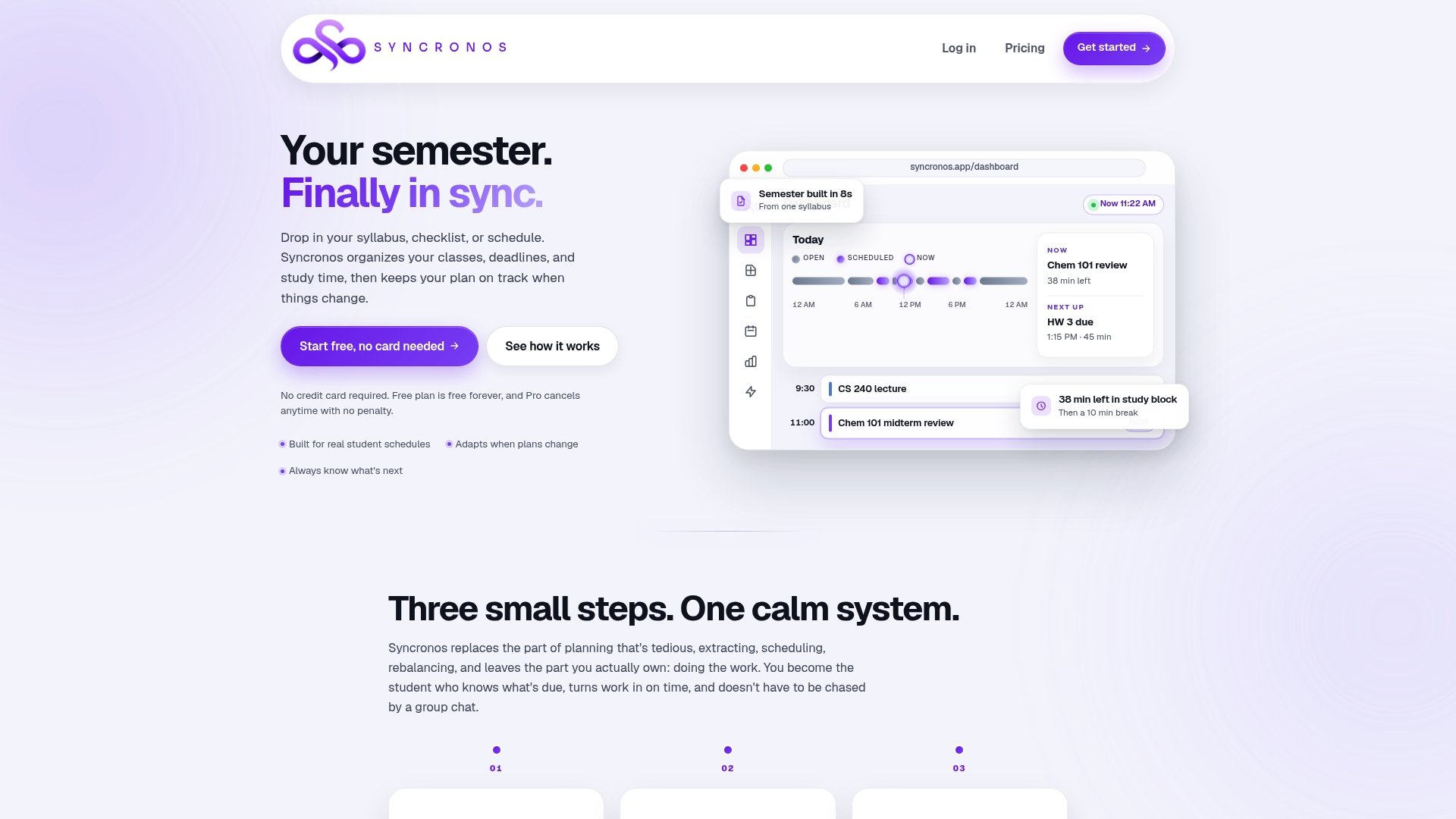
Uploading your syllabi and to-do lists to the tool extracts every exam date, project deadline, and grade weight automatically, with no manual data entry required. When a professor pushes back an exam or adds a review session, the adaptive scheduling engine rebalances your remaining study blocks instead of leaving you to redo the week by hand. A prioritized dashboard can show which course needs your next open hour based on factors like date, weight, and difficulty, helping you decide which subject deserves the next block.
For students juggling multiple finals and a stack of final papers, the assignment planner keeps project deadlines visible alongside exam dates instead of buried in a separate app. Start with the exam study planner and turn your syllabi into a working schedule in the time it would take to write out day one by hand.
Sources
For a printable five-day chart, see Cornell's five-day study plan. For exam-specific planning tools, check UNC's final exam planning guide and the Weingarten Center's finals plan walkthrough. For setting up a distraction-free study space at home, these organization tips are worth a look.
- Five-Day Study Plan — Cornell Learning Strategies Center
- Final exam planning tools — UNC Learning Center
- How to create a finals week study plan — Weingarten Center (UPenn)
- How to study for finals — University of Cincinnati