
The fastest way to get a group project on track is to create a one-page group charter, set milestone-based internal deadlines with a buffer phase, assign a recorder, and keep one master calendar. Syncronos automates part of this by pulling deadlines straight from an uploaded syllabus and generating a calendar around them. The next step is simple: schedule a kickoff meeting this week and lock in the plan before tasks pile up.
TL;DR:
- Creating a clear, one-page group charter with specific roles, deadlines, and escalation paths prevents conflicts and keeps everyone aligned.
- Breaking the final project deadline into multiple milestones with internal review dates maintains momentum and allows early issue detection.
- Assigning defined roles such as leader, recorder, and timekeeper, and rotating some roles each milestone, enhances accountability and schedule adherence.
- Using a single shared calendar or document for schedule updates and communication reduces confusion and ensures everyone stays informed.
- Automating schedule extraction and updates with tools like Syncronos can streamline planning and rebalancing when milestones shift, avoiding manual errors.
Table of Contents
- What to do in the next 24 to 48 hours
- Building a one-page group charter that actually gets used
- Turning the final due date into a milestone timeline
- Assigning roles and running meetings that protect the schedule
- Keeping communication in one place instead of five apps
- Running accountability checks without waiting for a crisis
- Which tools actually fit each part of the schedule
- Why most group schedules fail before the deadline even shows up
- A practical way to automate the schedule instead of managing it by hand
- Sources
- FAQ
What to do in the next 24 to 48 hours
Coordination problems start early, usually before anyone realizes a schedule is needed at all. A short, structured kickoff prevents the drift that turns a manageable project into a scramble.
- Schedule a 30 to 45 minute kickoff meeting to review the syllabus and confirm everyone's availability.
- Draft and sign a one-page group charter that sets meeting cadence and late-work rules.
- Pull every instructor deadline from the syllabus and set 3 to 5 interim milestones with internal review dates, plus a buffer for final assembly.
- Choose one master calendar or document hub that the whole team will treat as the single source of truth.
- Name a recorder and a primary communicator so updates have a clear owner.
- Assign tasks for the first milestone before the meeting ends.
- Confirm who updates the timeline after each future meeting.
Teams that finish these seven steps in the first two days rarely need an emergency meeting later in the semester.
Building a one-page group charter that actually gets used
A charter works only when it is short enough to read in two minutes and specific enough to settle arguments before they start. University guidance treats a signed charter with norms, roles, meeting rules, and a schedule as a standard practice for group assignments, and several universities publish sample templates for exactly this purpose.
A working charter needs these fields:
- Project name, course, and full list of members with contact information.
- Assigned roles: leader, recorder, timekeeper, and submission owner.
- Meeting cadence and preferred communication channel.
- Internal deadlines for each milestone, separate from the instructor's final date.
- A late contribution policy stating what happens when someone misses a deadline.
- An escalation path for unresolved conflict, including when to contact the instructor.
- A signature line for every member.
Pro Tip: Paste the charter into the same document you use as your master calendar, so nobody has to search for it later.
Store it somewhere permanent, not in a chat thread that scrolls out of view within a week.
Turning the final due date into a milestone timeline

A single deadline months away invites procrastination. Breaking the deliverable into staged components with their own due dates keeps momentum steady and gives the team early warning when something falls behind. Teaching-center guidance from Cornell University recommends milestone-based timelines with interim deadlines and internal review periods ahead of final submission.
A workable sequence for a semester-long project looks like this:
- Week 1 to 2: research and outline, with an internal review before moving on.
- Week 3 to 5: draft individual sections, each due on a staggered internal deadline.
- Week 6: full team review of the combined draft, flagging gaps.
- Week 7: revisions based on review feedback.
- Final 2 to 5 days: buffer for assembly, formatting, and proofreading.
That buffer matters more than it sounds. Illinois Online suggests at least two working days for typical written deliverables and three to five days for multimedia presentations or complex datasets. Put the buffer on the calendar as its own milestone, not as slack time that quietly disappears.
Assigning roles and running meetings that protect the schedule
Vague responsibility is the fastest way to lose a schedule. Duke Center for Teaching and Learning points to defined functional roles and short, regular check-ins as a consistent pattern in group projects that stay on track.
- Leader: keeps the agenda focused and drives decisions when the group stalls.
- Recorder: updates the master timeline and writes a short digest after every meeting.
- Timekeeper: keeps meetings inside their scheduled window.
- Submission owner: confirms the final file is formatted, complete, and submitted on time.
Practical advice from Harvard's Derek Bok Center treats a recorder distinct from the leader as one of the more reliable fixes for keeping a team on schedule, since someone is always accountable for capturing decisions.
Pro Tip: Rotate the leader and timekeeper roles each milestone, but keep the same recorder for the whole project so the timeline never loses continuity.

Keeping communication in one place instead of five apps
Group chats bury schedule changes under casual messages within days, and the systematic review on online group projects ties this kind of information fragmentation to uneven participation and unclear expectations. Fixing it starts with picking one authoritative document and one channel for anything urgent.
- Use a single calendar or shared document as the only place schedule changes live.
- Reserve a fast channel, such as text, strictly for genuinely urgent issues.
- Have the recorder post a short meeting digest within a day of every meeting.
- Name files with a consistent pattern and date, so the latest version is obvious.
- Send a brief weekly reminder of upcoming deadlines to catch anyone who missed an update.
None of this needs to be elaborate. It just needs to be the same place, every time.
Running accountability checks without waiting for a crisis
Free-riding rarely announces itself early, which is why a scheduled check-in matters more than an informal "everyone's fine, right?" Research summarized in a systematic review of online group projects identifies uneven participation as one of the most common problems teams face, and recommends clear guidance and regular support to reduce it.
- Run a short, anonymous mid-project check-in to catch imbalance before it becomes a grade issue.
- Ask each member to rate contribution, communication, and reliability on a simple scale.
- Run a second, final peer check that can factor into grading input.
- Document any missed deadline in writing, including what was reassigned and to whom.
- Involve the instructor once a pattern repeats after one direct conversation, not before.
A predictable rhythm here removes the awkwardness of raising concerns case by case.
Which tools actually fit each part of the schedule
Different tasks call for different tools, and forcing everything into one app usually backfires.
- A shared calendar for the master timeline that everyone can see at a glance.
- A collaborative document editor for the charter, drafts, and meeting digests.
- A simple task board for assigning and tracking who owns what.
- Cloud storage for the final assembly stage, so version confusion never surfaces at the deadline.
The natural workflow runs from syllabus to extracted deadlines, to milestones, to task assignment, to scheduled reviews, to peer checks, to the buffer and final assembly. Syncronos' syllabus-to-calendar feature automates the first step by pulling dates directly from an uploaded syllabus, and its adaptive rebalancing adjusts study blocks and deadlines automatically when a milestone shifts. That removes several of the manual steps described above without adding another app to check.
Why most group schedules fail before the deadline even shows up
Most scheduling failures come down to three habits: no one owns the timeline, no buffer exists before the deadline, and updates scatter across too many apps to track. Fix those three and most other problems become manageable.
Adaptive rebalancing and a single prioritized view of deadlines address exactly those failure points by keeping one timeline current automatically instead of relying on someone to remember. Apply the 24 to 48 hour checklist this week rather than waiting for the first missed deadline to force the issue.
— Syncronos
A practical way to automate the schedule instead of managing it by hand
Everything in this guide can be done manually with a shared document and some discipline, but Syncronos removes several of the manual steps by extracting deadlines directly from an uploaded syllabus and building the calendar automatically.
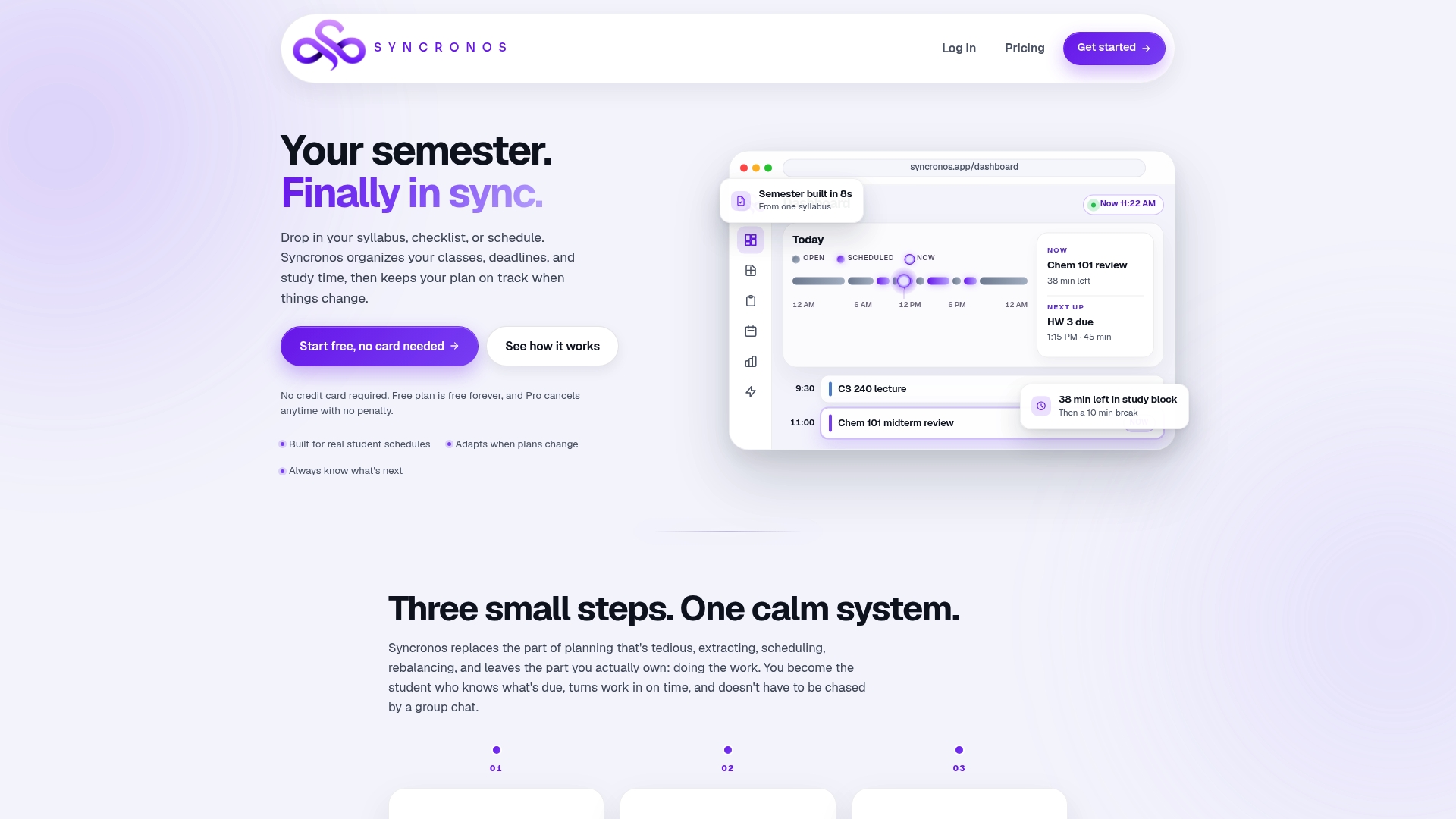
- Extracts assignment deadlines from a syllabus and generates a calendar without manual entry.
- Rebalances study blocks and deadlines automatically when a milestone or meeting time changes.
- Keeps a prioritized dashboard so the next task is always clear.
- Updates the master timeline in real time instead of relying on a recorder to catch every change.
Students can try the free tier to test the basics, or move to the Monthly plan at $8.99 per month or the Yearly plan at $55.99 per year for unlimited AI-powered scheduling and forecasting. Start with the syllabus-to-calendar tool to see how quickly a full semester schedule builds itself.
Sources
- How to create and manage collaborative learning | Cornell University
- Develop a group project assignment | CUNY
- Challenges and strategies for online group projects (systematic review) | PMC
- Group work guidance | Derek Bok Center, Harvard University
- Use student teams effectively | Duke Center for Teaching and Learning
FAQ
How do I schedule a group project with classmates?
Start with a kickoff meeting to review the syllabus, sign a one-page charter, and break the final deadline into 3 to 5 milestones with internal review dates. Assign a recorder to keep one master calendar updated after every meeting so the schedule never lives in scattered messages.
What should a group project charter include?
A charter should list member roles, meeting cadence, communication norms, internal deadlines, a late contribution policy, and a conflict escalation path, based on templates from CUNY and similar teaching centers. Every member should sign it before work begins.
How much buffer time should we build in before the deadline?
Plan for at least two working days of buffer before the deadline for typical written assignments, and three to five days for presentations or projects with complex data, according to Illinois Online. That buffer should sit on the schedule as its own milestone rather than unplanned slack.
How do we handle a teammate who isn't contributing?
Document the missed deadline in writing, reassign the task if the deadline is close, and raise the issue directly with the person first. If the pattern repeats after that conversation, bring it to the instructor, and use a mid-project peer check-in to catch the problem earlier next time.
Can Syncronos help with group project scheduling?
Syncronos is built for individual student planning, but its syllabus-to-calendar extraction and adaptive rebalancing can help a recorder keep a personal copy of the team's milestones current as deadlines shift. It works alongside a shared team calendar rather than replacing it.