

There is no universal best time to study. The right window depends on your chronotype and your sleep habits, not a rule that applies to everyone equally. A 2025 systematic review found cognitive performance peaks when people study at their biologically preferred time, and separate research on sleep and memory shows retention depends on what happens after you close the book. The sections below break down the trade-offs and give you a way to test your own peak window.
TL;DR:
- Around 45% of studies show a clear link between study timing and better cognitive performance, but individual variation means timing is not a universal rule.
- Material reviewed just before sleep can enhance consolidation if adequate sleep follows; skipping sleep eliminates this benefit.
- Matching high-demand tasks to your peak energy window maximizes learning, while lighter activities are better suited for low-energy periods.
- Maintaining a consistent study schedule and protecting sleep hours provides better long-term results than chasing the ideal study time.
- Using a two-week self-test to identify your best window, combined with automated scheduling tools, can optimize your study effectiveness and routine stability.
Table of Contents
- Morning vs Night Studying: Weighing the Real Trade-Offs
- What the Research Actually Says About Timing and Memory
- How to Find Your Best Study Window in Two Weeks
- Matching Tasks to the Right Time of Day
- Why Consistency Beats Chasing the "Perfect" Time
- Run Your Study Schedule on Autopilot With Syncronos
- Sources
- FAQ
Morning vs Night Studying: Weighing the Real Trade-Offs
Morning study and night study each solve different problems, and neither one wins outright. The honest comparison depends on what you're studying, how much sleep you're protecting, and how your brain actually behaves at different hours.
Morning sessions tend to work well because of a few consistent advantages:
- Fresh cognitive resources. After a full night's sleep, working memory and attention haven't been depleted by a day of decisions yet.
- Higher willpower. Self-control research consistently shows discipline erodes as the day goes on, so morning sessions face less resistance.
- Easier to schedule around. Classes, jobs, and social plans rarely compete for 6:00 to 8:00 a.m. the way they compete for 8:00 p.m.
- Lower distraction load. Fewer texts, fewer people awake, fewer notifications.
- Sets a consistent anchor. Starting the day with a study block builds a routine that's easier to repeat than an evening slot squeezed between other commitments.
Night study has its own case, and it's stronger for some students than research summaries often admit:
- Fewer interruptions once the world quiets down, especially in shared housing or family households.
- Higher reported creativity for some people during looser, less structured evening thinking.
- Proximity to sleep aids consolidation. Material reviewed shortly before bed can get tagged for overnight processing, according to sleep consolidation research.
- Natural fit for night owls, whose alertness genuinely peaks later, per reporting from Imperial College.
- Less competition with unavoidable daytime obligations like labs, work shifts, or commutes.
Both windows share the same failure modes: skipping sleep to squeeze in more hours, an inconsistent schedule that never lets a routine form, and the post-lunch dip that flattens focus for almost everyone regardless of chronotype. The practical rule holds either way: never trade sleep for study time. Pick your window based on your chronotype and your actual schedule constraints, not on what a productivity blog says you should prefer.
What the Research Actually Says About Timing and Memory
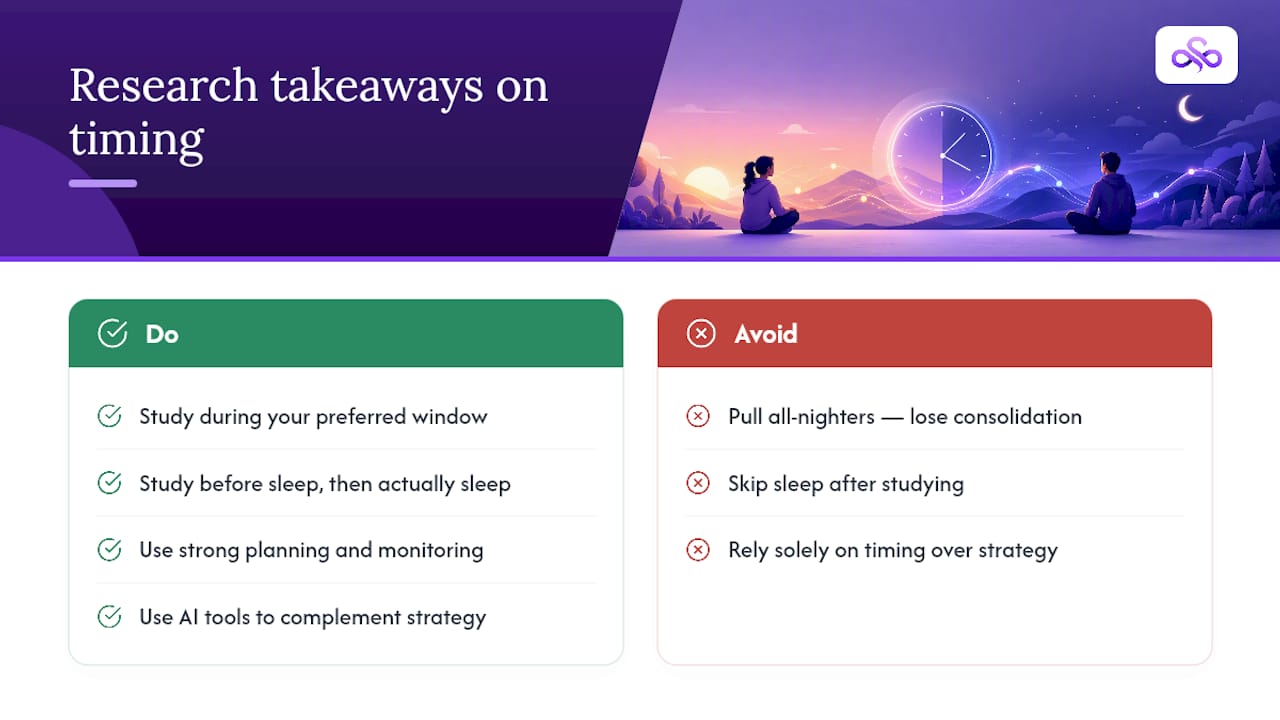
The clearest evidence comes from what researchers call the synchrony effect: cognitive performance, including attention, memory, and impulse control, tends to peak when someone studies during their biologically preferred window. A 2025 systematic review in Chronobiology International found this effect in roughly 45% of the studies it examined.
45% of reviewed studies showed a measurable synchrony effect between chronotype and study timing. That's a meaningful signal, not a universal law, since more than half the studies didn't find the same pattern, which tells you individual variation matters as much as any general timing rule.
Sleep plays its own separate role. Material studied close to bedtime can get consolidated more effectively overnight, but only when adequate sleep actually follows. The PMC review on sleep and memory is specific about that condition: skip the sleep, and the consolidation advantage disappears.
Studying before sleep can strengthen memory formation, but the benefit is conditional. Cut the sleep short, and you lose the gain you were trying to capture.
Strategy interacts with timing too; complementary AI learning tools can enhance study effectiveness, as seen at AtListen — AI-Powered Learning That Understands. A 2024 study on study strategies found that when planning, monitoring, and concentration are strong, students accomplish more in less time. Poor strategy often forces longer hours to reach the same result, which means a well-planned session at a mediocre time can outperform a poorly planned session at your "perfect" hour.
Here's the caution worth repeating: an all-nighter doesn't just cost you sleep, it erases the consolidation window entirely. Research synthesized by The Conversation shows extra study time helps only up to a point. Past that point, sacrificing sleep drags down both learning and next-day performance.
How to Find Your Best Study Window in Two Weeks
You don't need a sleep lab to figure out your peak window. A short, structured test tells you more than any generic morning-person or night-owl quiz.
- Pick two or three candidate windows (early morning, mid-afternoon, late evening) based on your existing schedule.
- Study the same type of material in each window for four to five days, keeping session length consistent.
- Rate your focus and productivity after each session on a simple 1 to 10 scale, logged immediately, not from memory later.
- Run a short retention check the next day, a five-question self-quiz on what you covered.
- Compare the logs after two weeks and look for the window with the highest average focus rating and retention score, not just the one that felt easiest.
Once you've identified your peak window, a few rules keep it working. Put new, difficult material into that peak block first. Schedule review sessions before sleep when possible, since that's when consolidation research shows the most benefit. Protect 7 to 9 hours of sleep as a fixed constraint, not a variable you cut when things get busy. Keep session length consistent, somewhere around 45 to 90 minutes at peak, switching to shorter Pomodoro-style intervals during lower-energy periods.
Pro Tip: If you're forced to study during a low-energy window, time your caffeine 30 to 45 minutes before the session starts, study somewhere with more light than usual, and break the material into micro-tasks you can finish in under 10 minutes each. That keeps momentum going when your natural alertness isn't.
Matching Tasks to the Right Time of Day
Not every study task deserves your peak window. Matching task difficulty to your energy curve gets more out of the same number of hours.
- High-demand tasks — learning brand-new material, solving unfamiliar problems, active recall drills — belong in your peak 45 to 90 minute block, whenever that falls for you.
- Mid or low-demand tasks — reviewing flashcards, organizing notes, light reading — fit naturally into afternoon troughs when focus dips but isn't gone.
- Creative or synthesis work — brainstorming essay angles, connecting ideas across a course — often suits the looser, more associative thinking many people report in the evening.
An early bird might front-load calculus problem sets at 7:00 a.m., review notes after lunch, and journal essay ideas at 8:00 p.m. A night owl could flip that entirely, saving hard problem-solving for 9:00 p.m. and using mornings for lighter review. A middle-of-the-road student often does best splitting hard tasks between a late-morning block and an early-evening block, avoiding the mid-afternoon slump altogether.
Why Consistency Beats Chasing the "Perfect" Time
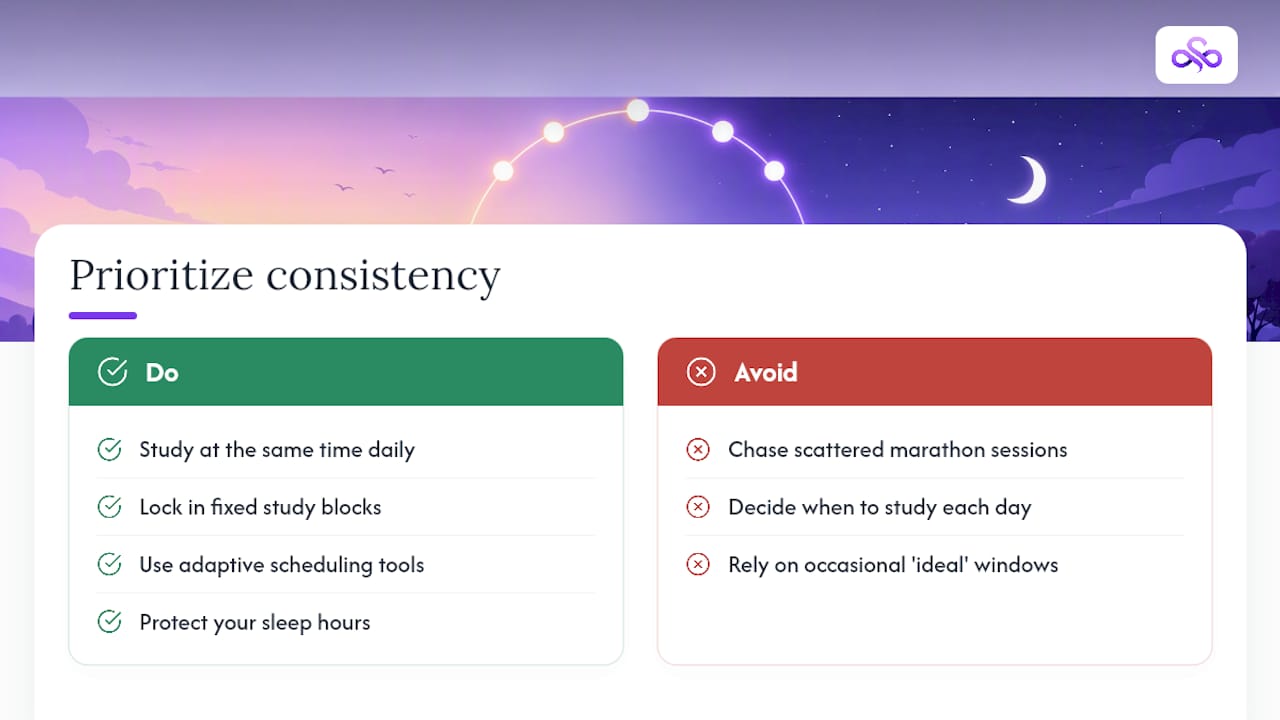
The evidence on chronotype and sleep is real, but the bigger lever most students ignore is consistency. A student who studies for 45 focused minutes at the same time every day will usually out-learn one who chases scattered, unpredictable marathon sessions, even if that second student technically hits their "ideal" biological window occasionally.
Decision fatigue is underrated here. Every time you have to decide when to study, you spend willpower before you've opened a single notebook. Adaptive scheduling tools that lock in study blocks and adjust automatically when a deadline shifts remove that friction, which protects both your peak windows and your sleep hours from getting quietly eaten by rescheduling. That's less about finding a magic hour and more about removing the daily negotiation over when to start.
— Syncronos
Run Your Study Schedule on Autopilot With Syncronos
Running the two-week test above is easy on paper and hard in practice once assignments pile up and deadlines shift without warning. Syncronos reads your syllabi, checklists, and to-do lists, then builds a calendar around them automatically, so you're not manually rebuilding your study blocks every time a due date changes.
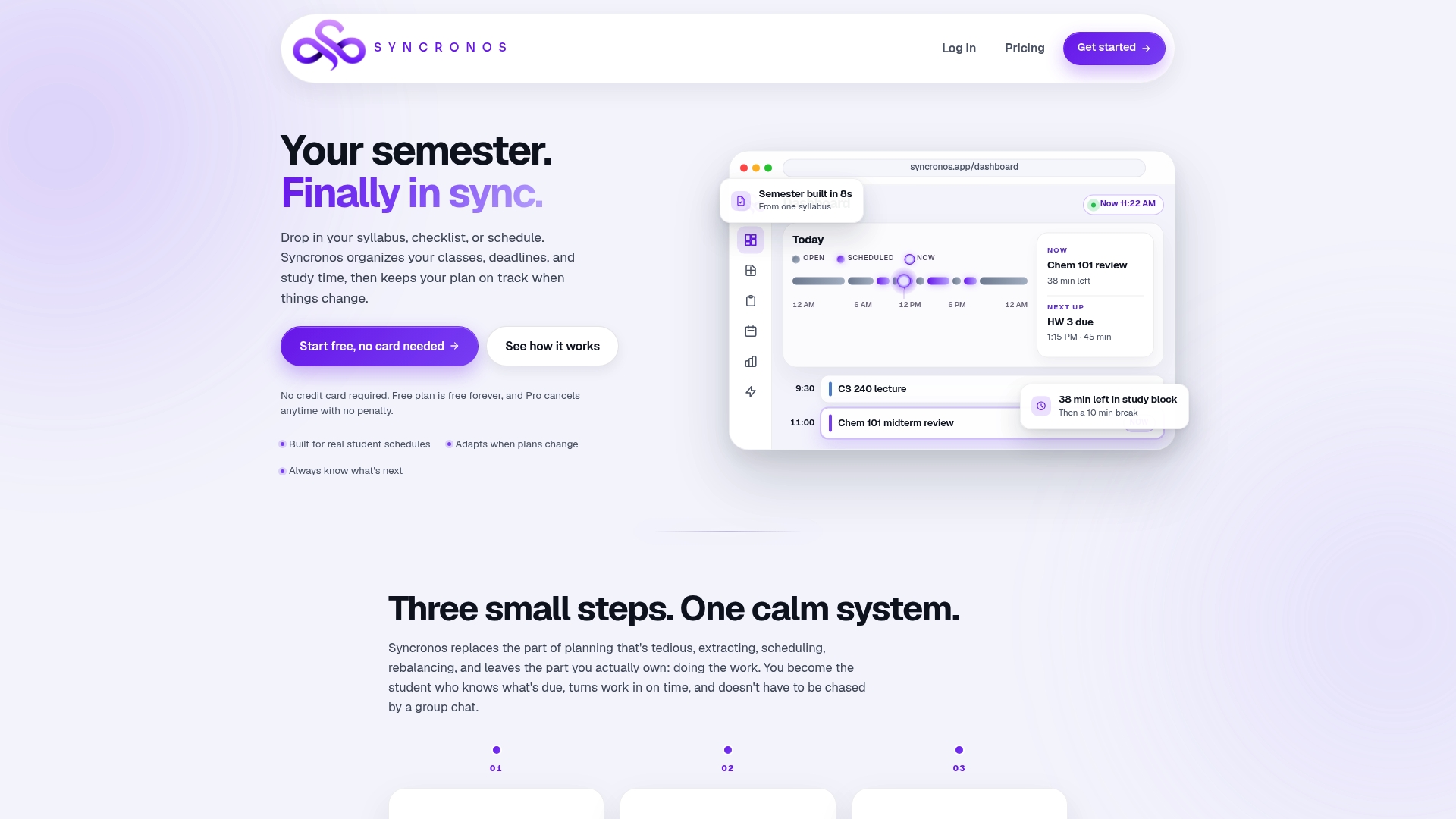
The AI study planner lets you lock in your peak window for new material and schedule lighter review sessions before bed, matching a recommended study pattern. When a professor moves an exam or adds a reading, Syncronos rebalances the rest of your week instead of leaving you to figure out what gets bumped. For readers heading into finals, the exam study planner turns your test dates into a prioritized set of study blocks without the manual math. Start by uploading one syllabus and see how the schedule builds itself around the study window you already tested.
Sources
- Chronobiology International systematic review (2025)
- Sleep and memory consolidation (PMC review)
- The Conversation: Goldilocks Day tool and study balance
FAQ
Is it better to study in the night or morning?
Neither is universally better. It depends on your chronotype, according to research on the synchrony effect, and on whether your evening study leaves room for enough sleep afterward.
Do you prefer to study in the morning or at night?
That's an individual question, not a scientific one. Early risers usually perform best tackling hard material in the morning, while confirmed night owls often show sharper focus later in the evening.
What is the 1/3, 5/7 rule in studying?
This isn't a standard, research-backed rule, and definitions of it vary widely online. Rather than relying on it, use the two-week self-test in this article to find a schedule that actually fits your own focus patterns.
What is the healthiest time to study?
The healthiest approach protects 7 to 9 hours of sleep regardless of which window you choose, since research on study balance shows sacrificing sleep for extra study hours backfires on next-day performance.