
A short daily routine of prioritized planning, paired with one or two quick relief tools like breathing or grounding, cuts student stress faster than any single fix. The baseline still matters: consistent sleep, short movement breaks, and breaking assignments into micro-steps. Planning tools can handle the scheduling part automatically, freeing up mental space for the actual work.
TL;DR:
- Prioritizing small, time-bound tasks and creating a detailed schedule for each assignment significantly reduces overwhelm and procrastination.
- Daily self-care routines, including consistent sleep, physical movement, and mindfulness, provide a steady baseline of lower stress levels.
- Quick relief techniques like breathing exercises and grounding can help regain focus within two minutes during acute stress episodes.
- Automating syllabus extraction and workload planning through specialized tools helps clarify deadlines and prevents last-minute panic.
- Recognizing warning signs of deeper mental health issues and seeking outside support is essential when stress persists despite self-help strategies.
Table of Contents
- Practical Strategies to Reduce School Stress Every Week
- Fast Relief Techniques for Acute Stress
- Turning a Syllabus Into a Stress-Free Schedule
- Daily Habits That Lower Your Baseline Stress
- When School Stress Needs More Than Self-Help
- Why Automated Planning Actually Reduces Panic
- A Note From Syncronos
- Try Syncronos to Take Planning Off Your Plate
- Sources
Practical Strategies to Reduce School Stress Every Week
Stress rarely comes from one big assignment. It comes from a pile of small, vague tasks that never get broken down, plus a schedule with no protected rest. Fixing that order of operations matters more than any single relaxation trick.
Here's a ranked approach that works whether you're in tenth grade or your third year of college:
- Break work into time-bound micro-tasks. Instead of "write the essay," schedule "outline three body paragraphs for 25 minutes." Specific, bounded tasks create momentum and cut the paralysis that leads to procrastination, according to the Jed Foundation.
- Build a weekly study block schedule. Assign fixed blocks to each class, and treat at least one evening as fully off-limits to schoolwork.
- Protect a daily self-care ritual. Adequate sleep, regular movement, and short screen-free breaks are important components of daily self-care. University health services increasingly frame self-care as a scheduled appointment, not something you fit in "if there's time," per Florida Atlantic University Student Health Services.
- Practice three to five minutes of mindfulness or breathing daily. Regular practice, not just emergency use, changes how your body responds to stress over time, according to Calm's research on school stress.
- Set realistic goals and stop multitasking. Splitting attention across five tabs and two group chats while "studying" adds cognitive load instead of saving time.
- Use your support network deliberately. Tell a parent, teacher, or roommate specifically what's stressing you out and what kind of help you need. The NHS lists asking for help alongside sleep and exercise as a core, evidence-based step, not a last resort.
Beyond that ranked list, a few smaller habits reinforce the whole system:
- Write tomorrow's top three tasks the night before, so your brain isn't rehearsing them at 1 a.m.
- Keep a single running list of deadlines instead of scattering them across sticky notes and group texts.
- Review your week every Sunday and adjust before Monday hits, not after.
Pro Tip: Pick one micro-task rule and reuse it everywhere: "20 minutes, one clear output." A vague task like "study biology" has no finish line, which is exactly why your brain avoids starting it.
Fast Relief Techniques for Acute Stress
When panic hits before a test or mid class, you need something that works in under two minutes.
- 4-6 breathing: Inhale for 4 counts, exhale for 6. Repeat five times. The longer exhale slows your heart rate faster than even breathing does.
- 5-4-3-2-1 grounding: Name 5 things you see, 4 you can touch, 3 you hear, 2 you smell, 1 you taste. It pulls your brain out of the spiral and back into the room.
- Two-minute movement reset: Stand, stretch your arms overhead, walk to a window and back. Short breaks reset cognitive focus more effectively than pushing through fatigue, according to Calm's guidance on school stress.
Nearly 75% of high schoolers and half of middle schoolers report constant stress about schoolwork, which is exactly why these tools need to be automatic, not something you have to think up in the moment.
Pro Tip: After any calming technique, immediately open your planner and schedule one micro-task. Calm without action fades fast; calm plus a concrete next step turns into momentum.
Turning a Syllabus Into a Stress-Free Schedule
Most academic panic traces back to one habit: treating a big assignment as one giant, undated block instead of a series of dated steps.
Take a 10-page research paper due in three weeks. Broken down, it looks like this:
- Week 1, Monday: Pick a topic and gather five sources (30 minutes).
- Week 1, Thursday: Write a one-page outline (20 minutes).
- Week 2, Tuesday and Thursday: Draft two pages each session.
- Week 3, Monday: Revise the full draft.
- Week 3, Wednesday: Final proofread, submit a day early.
Each step gets its own date and time estimate, not a vague "sometime this week."
For prioritization, sort tasks by urgent versus important rather than by whatever feels loudest. A quiz tomorrow is urgent. A paper due in three weeks is important but not urgent yet, until it suddenly is. Blocking study time with built-in breaks (50 minutes on, 10 minutes off works for most people) keeps you from burning out mid-week.
A visual calendar removes the uncertainty that fuels cramming. When every task has a date and a place, your brain stops running the "did I forget something" loop. That shift from mental tracking to visual tracking is one reason structured planning tools outperform memory alone, according to Colorado State University's stress management guidance. Tools built specifically for assignment planning or an AI study planner can generate this kind of breakdown automatically instead of leaving it to a Sunday-night scramble.
Daily Habits That Lower Your Baseline Stress
Some habits don't fix a single bad day, but they lower how stressed you run overall.
- Sleep hygiene: Keep a consistent bedtime, even on weekends, and cut screens 30 minutes before lights out.
- Nutrition: Eat on a regular schedule and keep balanced snacks (protein plus fiber) on hand instead of relying on vending machine sugar spikes.
- Movement: Even 10 minutes of walking or stretching between study blocks measurably improves focus for the next session, per Calm's tips on school stress.
- Caffeine timing: Cut caffeine by early afternoon so it doesn't sabotage the sleep you need to recover.
The NHS groups sleep, healthy eating, and physical activity together for a reason: they reinforce each other. Skip one and the others get harder to sustain.
When School Stress Needs More Than Self-Help
Some warning signs mean it's time to bring in outside support rather than push through alone.
- Sustained sleep loss lasting more than a week or two
- Withdrawing from friends, activities, or classes you used to care about
- Grades dropping sharply with no clear cause
- Persistent hopelessness or feeling like nothing will improve
If any of these sound familiar, talk to a school counselor, campus health office, or a trusted adult, and describe specifically what's changed and for how long. NIMH's resources on stress-related conditions outline these symptoms in more detail. If you ever feel unsafe or have thoughts of self-harm, contact emergency services or a crisis line immediately, not later.
Why Automated Planning Actually Reduces Panic
Most academic stress isn't about workload. It's about uncertainty: not knowing exactly what's due when, or how everything fits together. Visualizing tasks on a calendar restores a sense of control that a mental to-do list never provides, a pattern confirmed by Colorado State University's research on college stress management.
Some planning tools address this directly by pulling deadlines out of syllabi and to-do lists and turning them into a scheduled, prioritized view. Its core functions:
- Syllabus extraction: Upload a syllabus and it converts to a calendar automatically.
- Prioritized dashboard: See what's actually due next instead of guessing.
- Adaptive rebalancing: When a deadline shifts, Syncronos redistributes your remaining study blocks instead of leaving you to redo the math manually.
Pro Tip: If a due date moves, don't rebuild your whole week by hand. Let adaptive rescheduling absorb the change so one shift doesn't cascade into three missed sessions.
A Note From Syncronos
We get it: stress rarely comes from laziness, it comes from too many moving pieces. Pick one or two tactics from this article and stick with them for two weeks. Consistency beats perfection, and a tool built to hold the schedule for you can carry some of that weight.
— Syncronos
Try Syncronos to Take Planning Off Your Plate
There are alternatives to building your own spreadsheet or juggling five separate to-do lists: some tools read syllabi and assignment sheets and turn them into a scheduled, prioritized calendar that adjusts automatically when a deadline moves.
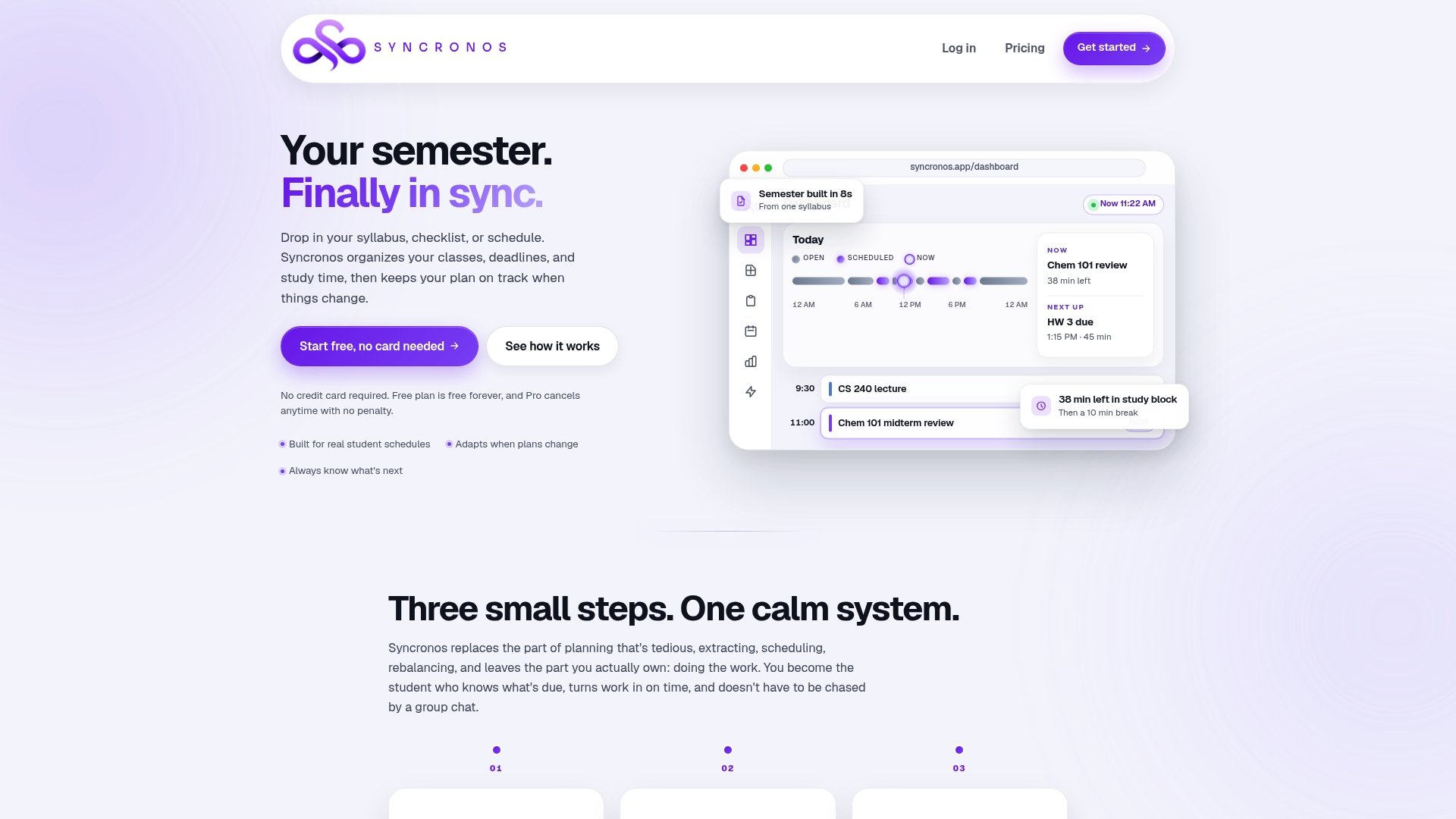
Here's what it automates once you upload your course materials: syllabus extraction into dated tasks, an assignment planner that breaks big projects into micro-steps, and adaptive rescheduling that rebalances your workload whenever a due date shifts. Students juggling multiple courses with unpredictable schedule changes benefit the most, since manual replanning is exactly where most academic stress starts. For exam periods specifically, the exam study planner builds a countdown schedule instead of a last-minute cram session, similar in spirit to how TEAS 7 test-prep guides map study time to measurable targets rather than open-ended review.
Start with the free tier and upload one syllabus to see your first automated schedule, no commitment required.
Sources
- So stressed out — NIMH
- Student stress - NHS
- 8 Ways to Lower Stress in High School — Jed Foundation
- 10 ways to manage stress in college — Colorado State source