
Pick three SMART semester goals, extract every milestone from your syllabi during Week Zero, and convert each goal into calendared weekly checkpoints. Attach retrieval practice and spaced review to each checkpoint, then run a five-minute weekly check-in to catch problems early. The SMART framework gives structure; a tool like Syncronos gives you the calendar to execute it without manual upkeep.
TL;DR:
- Setting three SMART goals across different categories enhances focus and prevents overextension, increasing the likelihood of semester success.
- Creating a comprehensive calendar from syllabi during Week Zero enables early milestone planning and reduces last-minute deadline conflicts.
- Attaching evidence-based strategies like retrieval practice and spaced review to weekly checkpoints significantly improves retention and exam readiness.
- Protecting focused study blocks by layering them around fixed commitments ensures consistent effort and minimizes schedule disruptions.
- Using automated tools like Syncronos to update and rebalance your calendar prevents schedule failures caused by shifting deadlines or emergencies.
Table of Contents
- Top Semester Study Goals You Can Adopt Today
- How to Write a SMART Semester Goal (Templates You Can Copy)
- From Syllabus to Weekly Checkpoints: Set the Semester Calendar
- Attach Evidence-Based Study Strategies to Each Goal
- Design Your Weekly Schedule and Protect Study Blocks
- Measure Progress and Revise Goals
- Copy-Ready SMART Goal Examples and Short Templates
- Why Turning Goals Into a Calendar Actually Works
- Turn These Goals Into a Calendar Automatically
- Worksheets, Guides, and Studies Worth Bookmarking
- Sources
- FAQ
Top Semester Study Goals You Can Adopt Today
Good semester goals span more than GPA. They cover milestones, skills, habits, and the physical basics that make studying possible in the first place.
- Academic: raise your average in one difficult course by a measurable margin, such as improving your quiz average through consistent practice.
- Milestone: complete a research proposal draft by Week 6 and a final version by Week 11.
- Skill: master a core lab technique, coding library, or statistical software tool by Week 10.
- Habit: run three focused 25-minute study blocks per week for your hardest course, no exceptions.
- Wellbeing: hold a consistent sleep schedule, since sleep loss undercuts even the best study plan.
Pick three from these categories rather than one from each. Trying to chase too many priorities at once is how most semester plans quietly fail early in the term.
How to Write a SMART Semester Goal (Templates You Can Copy)
SMART goals work because they force a vague intention into something you can actually schedule. Here's what each letter means for a semester goal, not a corporate one:
- Specific: name the exact course, skill, or outcome. Not "study more," but "review Organic Chemistry reaction mechanisms."
- Measurable: attach a number. "Complete two 90-minute review sessions per week."
- Achievable: check it against your actual course load, not your ambition.
- Relevant: tie it to a grade, requirement, or skill you genuinely need this term.
- Time-bound: set an end date. "Through Week 12" beats "eventually."
Turned into a full sentence: "study more" becomes "complete two 90-minute review sessions per week for Organic Chemistry through Week 12."
Three templates to copy directly:
- Grade target: "Raise my [course] average from [X%] to [Y%] by Week [N] through weekly practice quizzes."
- Skill target: "Master [specific skill] by Week [N], demonstrated by [concrete output]."
- Habit target: "Complete [N] focused study blocks per week for [course] through Week [N]."
From Syllabus to Weekly Checkpoints: Set the Semester Calendar
Every syllabus you receive in Week 1 is a hidden project plan. The problem is that none of them are synced to each other, which is exactly why students miss overlapping deadlines they saw coming weeks earlier.
- Week Zero: collect every syllabus and enter every deadline into one semester calendar, with reminders set at one week and 48 hours out. This single habit is what separates a manageable semester plan from a reactive one.
- Identify milestone weeks (midterms, project deadlines, presentation dates) and work backward from each to set weekly checkpoints leading up to it.
- Run a short weekly planning session, 20 to 30 minutes, to scan the next two weeks, place review sessions, and reserve early blocks for the largest tasks.
- Build in flex weeks. Add one hour of contingency time weekly so a surprise assignment doesn't collapse your whole schedule.
Pro Tip: Do your Week Zero setup before classes get heavy, ideally during syllabus week itself. Milestones extracted early are milestones you can actually plan around instead of discovering in a panic.
Attach Evidence-Based Study Strategies to Each Goal
A calendar full of checkpoints only works if what happens inside each block actually builds retention. Not all study techniques are equal, and the research here is fairly consistent.
- Retrieval practice: testing yourself on material beats rereading it, in study after study.
- Spaced repetition: review material at Day 1, Day 3, and Day 7 after first learning it, rather than cramming the week before an exam.
- Elaboration: explain concepts in your own words or connect them to something you already know.
- Strategic mindset: simply asking yourself which strategy fits a task before you start studying increases your odds of using an effective one.
A meta-analysis on learning strategy instruction found that teaching cognitive, metacognitive, and management strategies correlates with measurable gains in academic performance. Separately, research on strategic mindset interventions found that students who were prompted to ask strategy-eliciting questions showed higher intentions to use effective strategies, tied to modest but real increases in semester GPA.
For quantitative courses, build weekly checkpoints around mixed-problem sets. For theory-heavy courses, turn lecture headings into questions and quiz yourself on them at your D1/D3/D7 intervals.
Design Your Weekly Schedule and Protect Study Blocks
Map your fixed commitments first: classes, work shifts, commute time. Only after that layer is locked in should you place study blocks into what's left. Academic success research from the University of Tennessee points to this order specifically, because study blocks placed before fixed commitments tend to get bumped the moment life happens.
- Use three 25-minute focused blocks per week for each hard course, clustered on non-back-to-back days.
- Add a 10 to 15 minute buffer after each block for notes or a short break.
- Online students should anchor blocks to natural breaks in asynchronous coursework rather than a rigid clock.
- In-person students should shift blocks around commute time rather than fighting it.
Measure Progress and Revise Goals
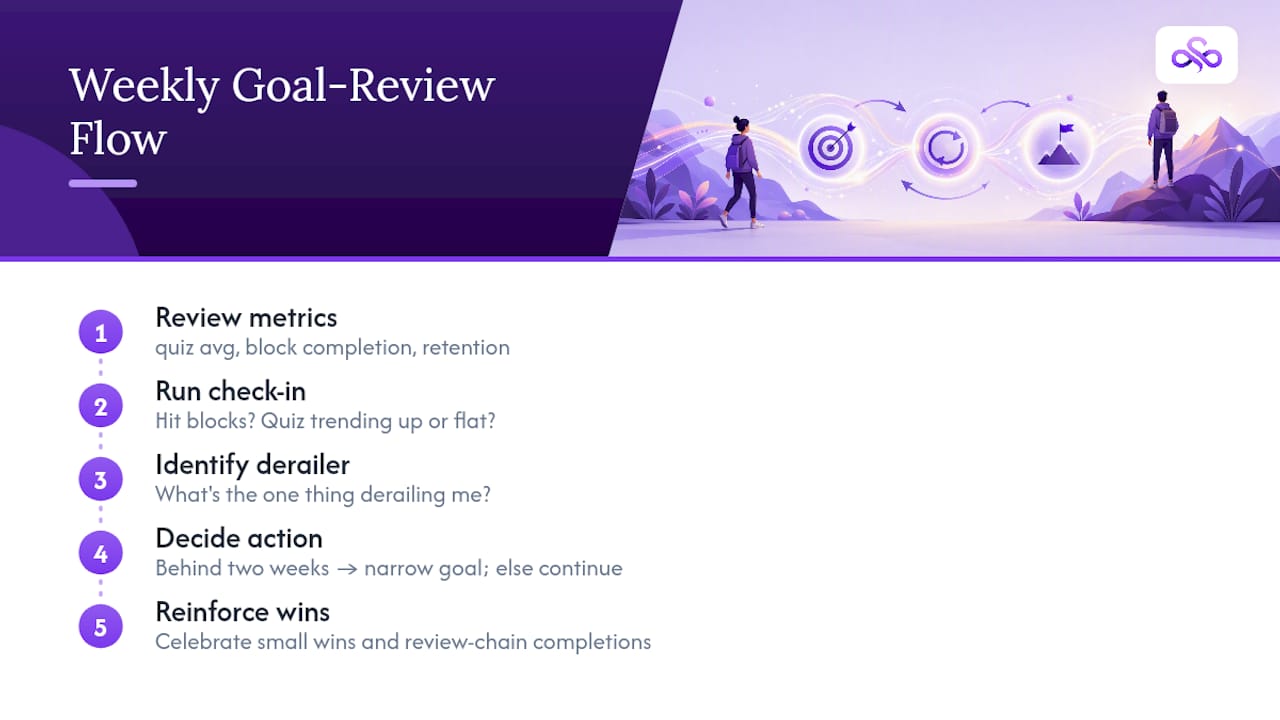
Track three simple metrics weekly: your quiz or assignment average, your completion rate for scheduled study blocks, and a self-test retention score for material you reviewed that week.
Run a short check-in every week with questions like: Did I hit my planned blocks? Is my quiz average trending up or flat? What's the one thing derailing me? If you're behind two weeks running, cut your goal's scope rather than abandoning it. Celebrate small wins, a completed review chain, a quiz score bump, since translating big goals into weekly action is what actually sustains motivation across 15 weeks.
Copy-Ready SMART Goal Examples and Short Templates
Here are concrete examples you can adapt directly, each broken into weekly execution:
- Grade goal: set a target to raise your weekly quiz average by a meaningful margin through regular retrieval practice sessions.
- Vocabulary goal: "Learn 20 new vocabulary words per week with 80% retention by Week 10" using spaced flashcard review at D1/D3/D7.
- Writing goal: "Complete a research proposal draft by Week 6" with weekly 45-minute writing blocks.
- Skill goal: "Master three core Python libraries by Week 10" through weekly applied practice problems.
- Habit goal: "Complete three 25-minute focused blocks weekly for Statistics through Week 14."
For a heavy exam week, shift checkpoints two weeks earlier for the exam's course, add one extra review block, and drop a lower-priority habit goal temporarily rather than dropping the exam prep itself.
Why Turning Goals Into a Calendar Actually Works
Motivation doesn't run out because students stop caring. It runs out because logistics, remembering deadlines, resequencing tasks, quietly eat the mental bandwidth meant for actual studying. Goals survive the semester when the calendar carries that weight instead of your memory. Expect to revise your plan more than once. That's iteration working, not failure.
— Syncronos
Turn These Goals Into a Calendar Automatically
Syncronos removes the one step most students skip: rebuilding a calendar every time a syllabus changes or a deadline shifts. Upload your syllabi and to-do lists, and Syncronos extracts every deadline and milestone into a single calendar, then rebalances your study blocks automatically when a professor moves an exam or you add a new commitment.
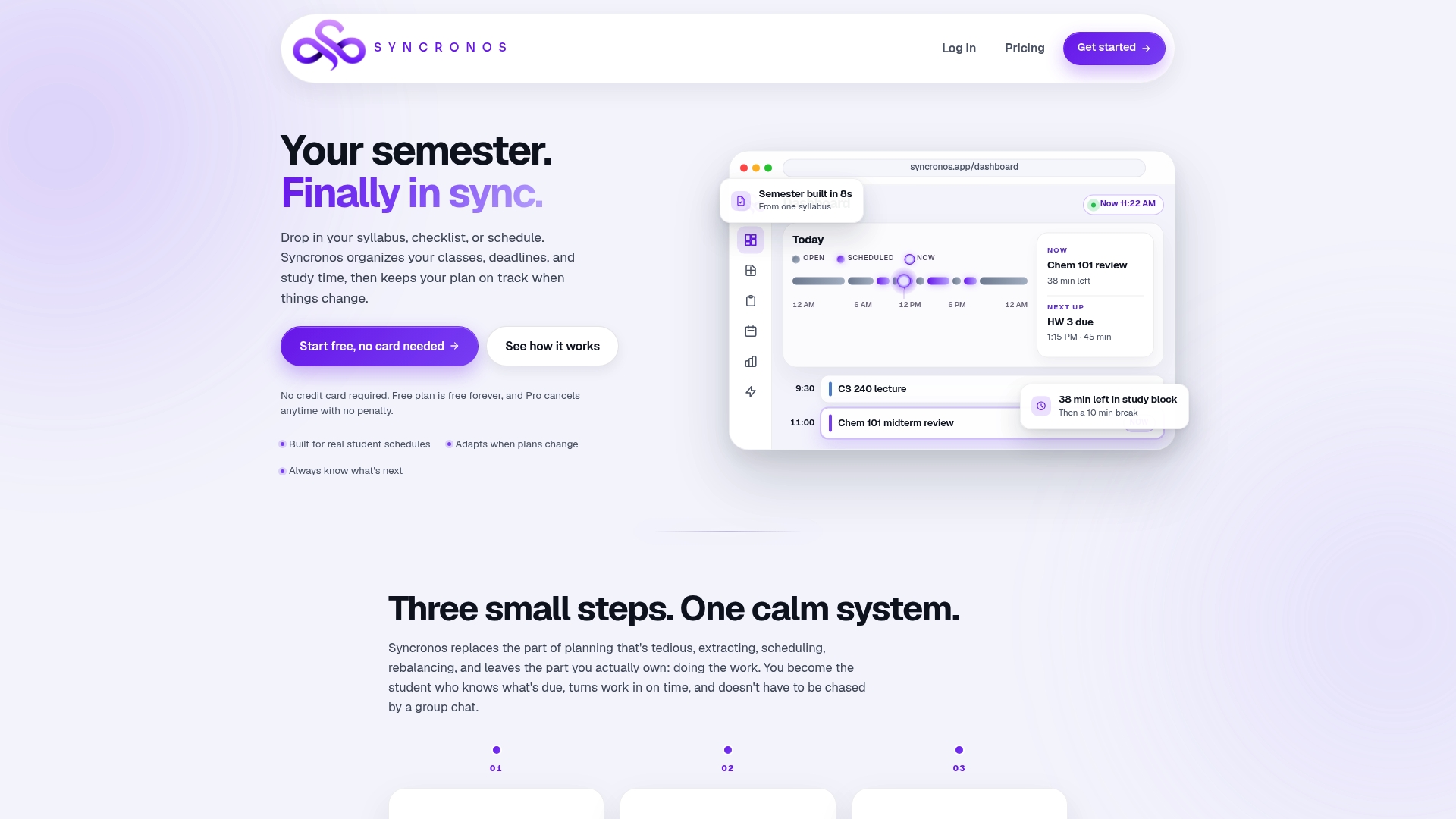
This matters most for students juggling a job, multiple hard courses, and the kind of schedule where one change cascades into three others. Instead of manually resequencing your review chain every week, Syncronos keeps your protected study blocks intact and adjusts around them. If you're building the three SMART goals and weekly checkpoints described above, start by uploading your syllabus to the assignment planner and let it generate your first week of checkpoints. Compare that to a manual planner from a partner resource like AmmarAI's guide to AI for students, and you'll notice the difference is the rebalancing, not just the scheduling. Try a free version and see your semester mapped out in minutes.
Worksheets, Guides, and Studies Worth Bookmarking
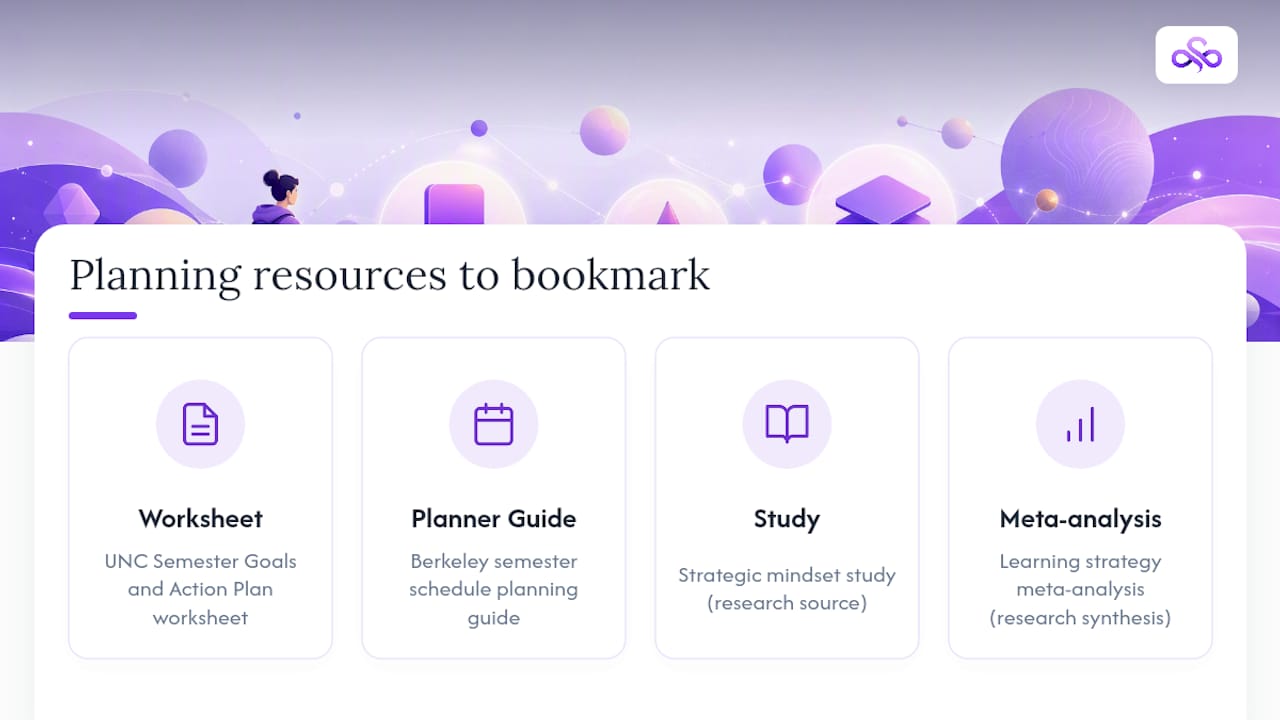
For hands-on planning, use UNC's Semester Goals and Action Plan worksheet and Berkeley's semester schedule planning guide. For the research behind the methods here, see the strategic mindset study and the learning strategy meta-analysis.
Sources
- Semester Goals and Action Plan (worksheet) | UNC Learning Center
- Academic success strategies | University of Tennessee Center for Student Success
- The Ultimate Semester-Long Study Plan with Smart Checkpoints
FAQ
What Are Some Good Semester Goals?
Strong semester goals mix categories: a grade target in one hard course, a milestone deadline for a major project, a skill to master, a weekly study habit, and a wellbeing goal like consistent sleep. Pick three, not five, and make each one SMART.
What Should Your Goals Be This Semester?
Your goals should reflect what's actually at risk this term, usually your hardest course, a major deliverable, or a skill your degree requires. Choose specific, measurable targets tied to weekly actions rather than broad intentions like "do better."
What Are Some Study Goals for Students?
Effective study goals focus on process, not just outcome: running consistent retrieval-practice sessions, completing a D1/D3/D7 review chain, or hitting a set number of focused study blocks weekly. A tool like Syncronos can turn these into calendared checkpoints automatically.
What Are Five Academic Goals for a Semester?
Five solid academic goals cover different needs: raise one course average by a set percentage, finish a major assignment draft by a target week, master a specific skill or software, complete three weekly study blocks per hard course, and maintain a consistent sleep schedule to support retention.