
Study burnout prevention comes down to five practices done consistently: protecting sleep, scheduling real rest, moving your body regularly, staying connected to other people, and setting boundaries around study time. These recommendations draw on peer-reviewed research, university handbooks, and guidance from the American Psychological Association, and they work better together than any single fix applied alone.
TL;DR:
- Consistent sleep of 7 to 9 hours with a fixed schedule and screen curfew significantly reduces burnout risk and supports recovery.
- Building social support and addressing perfectionism through reframing and process-focused goals improve resilience and lower emotional exhaustion.
- Implementing weekly off-days and quarterly breaks, scheduled in advance, prevents study overload and helps sustain long-term mental health.
- Automating study schedules with adaptive tools decreases decision fatigue, allowing students to maintain focus on sleep, movement, and social activities.
- A structured 14-day recovery protocol centered on sleep, gentle activity, and gradual re-engagement often restores students within a few weeks, emphasizing early intervention.
Table of Contents
- What academic burnout is and why prevention matters
- Early warning signs of study burnout
- Evidence-based prevention strategies that hold up
- Daily and weekly scheduling tactics that prevent burnout
- How reducing planning burden helps prevent burnout
- A short structured recovery protocol for burnout
- When to seek help and how to use campus resources
- Quick prevention checklist and process metric tracker
- An educator's view on catching burnout early
- A lighter way to protect your study schedule
- Selected authoritative research and guidance
- Sources
- FAQ
What academic burnout is and why prevention matters
Academic burnout has three recognizable parts: exhaustion that does not lift with a weekend off, a growing cynicism or detachment toward coursework, and a sense that your effort no longer produces results. Researchers describe it as an imbalance between demands (deadlines, exams, expectations) and resources (sleep, support, recovery time). When demands consistently outpace resources, the body and mind start running a deficit that willpower cannot cover.
This matters because burnout is not just an unpleasant feeling to push through. It changes how the brain processes information: concentration narrows, memory retrieval slows, and motivation drops even for subjects a student once enjoyed. The Academic Burnout Reduction Handbook frames prevention as a multi-level effort, one that combines social-emotional skill building, sleep protection, physical activity, and coordination between schools and families rather than relying on a single intervention.
That framing explains why prevention beats reaction. Once burnout sets in, the same study habits that used to work stop producing results, which often pushes students to study harder, sleep less, and dig the hole deeper. Catching the imbalance early, before exhaustion turns into detachment, is far easier than climbing out after weeks of depletion. The rest of this guide treats prevention as the primary goal and recovery as the backup plan for when prevention slips.

Early warning signs of study burnout
Burnout rarely arrives all at once. It builds through small signals that are easy to explain away, especially for students who pride themselves on pushing through.
Physical signs often show up first. Chronic fatigue that persists after a full night's sleep, frequent headaches, and vague somatic complaints like stomach upset before study sessions are common early markers. Sleep itself becomes unstable: falling asleep gets harder, or sleep feels unrefreshing even at a normal duration.
Cognitive and behavioral changes follow. Concentration becomes harder to sustain, practice test scores start slipping even though study hours have not changed, and interests narrow: a student who used to read for fun or maintain hobbies outside class starts dropping everything that is not directly tied to grades.
Emotional shifts round out the picture: irritability with classmates or family, a cynical attitude toward assignments that once felt meaningful, and a growing reliance on caffeine or stimulants just to reach a baseline level of function. Clinicians sometimes call this last pattern "chemical scaffolding," using substances to prop up a system that is quietly failing underneath.
High-achieving students deserve a specific note here. Grades and output can stay steady even as internal resources run out, which means performance is often the last thing to change, not the first. Clinical commentary on burnout in high-achieving students points to physiological and behavioral markers, sleep duration, resting heart rate, narrowing interests, as earlier and more reliable signals than test scores.
A few red flags call for action within two weeks rather than a wait-and-see approach:
- Sleep disruption lasting more than five consecutive nights despite a consistent bedtime.
- A noticeable drop in practice scores or assignment quality compared to a month earlier.
- Loss of interest in activities that used to feel enjoyable, not just less time for them.
- Increasing reliance on caffeine, energy drinks, or stimulants to get through a normal day.
Evidence-based prevention strategies that hold up
Five categories of intervention show up repeatedly across the research on academic burnout, and each one addresses a different part of the demands-and-resources equation.
Protect sleep first. Among lifestyle factors, sleep quality and consistency has the strongest evidence base for both preventing and recovering from academic burnout, according to a synthesis of sleep and burnout research. The practical version is simple: aim for 7 to 9 hours on a consistent schedule, and set a screen curfew 30 to 60 minutes before bed. Consistency matters as much as duration. A student who sleeps 7 hours at the same time every night tends to fare better than one who sleeps 9 hours some nights and 5 on others.
Move regularly, even in small doses. A 2026 study in Frontiers in Psychology found that regular physical activity moderates the relationship between academic stress and burnout: students who exercised consistently showed higher self-control and lower burnout, even when stress and screen time were otherwise similar to their peers. You do not need a gym membership to get this benefit. A brisk 20-minute walk between study blocks, a bike ride to campus, or a short home workout counts. For students at a desk most of the day, small posture and movement aids can help too. Sites like Tranquilora's roundup of desk-friendly wellness devices cover low-cost tools that encourage standing breaks and stretching without requiring a full routine change.
Build social support deliberately. Isolation tends to make academic stress feel heavier than it is. Guidance from the UCCS resilience center notes that social support often outperforms solo coping strategies, meaning a study group, a regular call with family, or even a shared meal with classmates does more for resilience than another hour of solitary review. Building this support does not require a large network. One or two consistent relationships, checked in with weekly, tend to be enough.
Address perfectionism directly. Perfectionism and imposter feelings push students to treat every assignment as a referendum on their worth, which turns ordinary setbacks into crises. Cognitive reappraisal, reframing a low grade as information rather than a verdict, helps break this pattern. So does shifting attention from outcome metrics (the grade itself) to process metrics (did you sit down and study for the planned window today). The Yale Poorvu Center's guidance on imposter stress recommends treating rest as a scheduled requirement rather than something earned only after finishing everything else.
Set boundaries and schedule rest like an obligation. A weekly off-day and a quarterly multi-day break, planned in advance rather than taken only when things fall apart, keep rest from becoming the first thing cut when deadlines pile up.
- Pick one full day each week with no assigned coursework, and mark it on the calendar at the start of the term.
- Block a three- to four-day break each academic quarter before the term even begins.
- Treat both as fixed commitments, the same way you would treat an exam date.
Pro Tip: Schedule your weekly off-day before you schedule anything else for the week. Rest that gets fit in around study blocks almost always gets canceled first.
Daily and weekly scheduling tactics that prevent burnout
Turning these strategies into a working schedule takes a bit of structure, but not much. Here is a sequence that works for most course loads.
- Set your weekly off-day at the start of the term. Choose one day and block it in your calendar before assigning any study sessions to that week, so it never gets treated as negotiable.
- Plan quarterly breaks in advance. Mark a three- to four-day stretch every quarter, ideally timed after a major exam or project deadline, and protect it the same way you would protect exam dates.
- Build single-task study blocks of 25 to 90 minutes. Shorter blocks suit dense material like problem sets, while longer blocks fit reading or writing. Avoid multitasking within a block: one subject, one task, one window.
- Slot in movement and social time between blocks. A 10-minute walk or a short conversation between two study sessions resets attention better than scrolling a phone.
- Track a small set of process metrics daily. Log hours slept, whether you moved your body, and whether you completed the planned study block, not the grade you got. These three numbers catch drift before a grade does.
- Set phone and caffeine rules that protect sleep. Stop caffeine by early afternoon and put the phone outside arm's reach for the last 30 minutes before bed. Both rules protect the sleep window that everything else depends on.
Reviewing these process metrics once a week, rather than waiting for a grade to drop, is what catches burnout while it is still small enough to correct with a light adjustment.
How reducing planning burden helps prevent burnout
A quieter contributor to burnout is decision fatigue: the mental cost of deciding, night after night, what to study next, how to fit in a deadline that moved, and what to cut when two assignments collide. Every one of those decisions competes with sleep, especially when they happen at 11 p.m. because the day's plan fell apart.
Adaptive scheduling tools reduce this load by handling the rebalancing automatically. When a deadline shifts or a new assignment appears, the schedule adjusts itself instead of asking you to manually reshuffle a week's worth of study blocks. This is where an adaptive scheduling tool fits into a prevention plan: it extracts tasks and deadlines from syllabi and to-do lists, builds a calendar automatically, and rebalances study blocks in real time as plans change. The goal is fewer late-night trade-offs that quietly eat into sleep.
A short checklist makes this practical:
- Set your weekly off-day and quarterly breaks as fixed blocks before letting any tool auto-schedule around them.
- Turn on rebalancing rules so a shifted deadline does not silently overload the following week.
- Audit your calendar once a week to confirm rest blocks are still intact and protected.
Used this way, an adaptive planner supports the behavioral changes already covered here. It does not replace sleep, movement, or a support system, but it removes some of the friction that makes those things harder to protect.
A short structured recovery protocol for burnout
When prevention has already slipped and burnout has set in, a structured recovery approach helps more than trying to push through a bad stretch. Recovery guides describe a 14-day protocol built around three phases: full stop, re-engage, and graded return.
- Days 1 to 3: full stop. Prioritize sleep above everything else, take short outdoor walks, eat on a regular schedule, and tell one trusted person what you are dealing with. No studying, no catch-up work.
- Days 4 to 7: reintroduce light activity. Bring back social contact and low-stakes hobbies while keeping the sleep and movement routines from the first phase in place.
- Days 8 to 14: graded study re-entry. Return to studying using process metrics, not outcome goals, and avoid high-stakes practice tests during this window. Use the final days to plan the next 30 days with protected rest already built in.
A structured short recovery protocol like this one reliably helps many students recover within a few weeks, according to recovery guidance built around the full stop, re-engage, graded return model. Practitioner-level advice adds one more rule: avoid making major decisions, dropping a class, switching majors, during the acute phase, since judgment tends to be skewed until baseline sleep and mood are restored.
If two weeks of this protocol produce no improvement, or symptoms deepen instead of easing, that is the signal to escalate beyond self-directed recovery and bring in professional support.

When to seek help and how to use campus resources
Some signs call for professional help rather than a self-directed recovery plan. Persistent thoughts of self-harm, a prolonged inability to attend class or complete basic tasks, or insomnia that does not respond to two weeks of consistent sleep habits all warrant a step beyond the protocol above. Clinical guidance on understanding student burnout recommends seeing a primary care provider or counselor when exhaustion or loss of motivation starts interfering with daily functioning.
Most campuses offer several entry points: a counseling center for ongoing support, a primary care appointment for a physical evaluation, and a disability or accommodations office for adjusting deadlines during a rough stretch. Crisis lines exist for anything urgent and should never feel like a last resort.
Requesting an extension does not require elaborate justification. A short, direct message works: "I'm dealing with a health issue that is affecting my ability to complete this on time. Could we discuss an extension or alternative arrangement?" Documentation from a counselor or physician strengthens a formal accommodations request, so it is worth keeping a simple record of appointments and dates if you plan to pursue one.
Quick prevention checklist and process metric tracker
A short daily checklist keeps prevention concrete instead of aspirational.
- Slept 7 to 9 hours on a consistent schedule.
- Moved your body for at least 20 minutes.
- Protected today's rest block without rescheduling it away.
- Had one real social contact, in person or by call.
- Completed one planned process metric, regardless of outcome.
If three or more days in a two-week window show a missed sleep target or a skipped process metric, treat that as the trigger to start the recovery protocol above rather than waiting for a grade to confirm it.
An educator's view on catching burnout early
Prevention is almost always easier than repeated recovery. Structural changes, a protected calendar, a weekly check-in with a friend, do more over a semester than any short burst of motivation ever will. If you take one thing from this guide, pick a single change this week: block your off-day, text someone you trust, or set a bedtime and keep it. Small, consistent structure beats willpower every time.
— Syncronos
A lighter way to protect your study schedule
Behavioral changes carry most of the weight in preventing burnout, but the daily work of managing a shifting schedule, a moved deadline here, a new reading there, adds friction that makes those changes harder to sustain. This type of tool is built to absorb that friction. It reads your syllabi and to-do lists, builds a calendar automatically, and rebalances study blocks in real time when something changes, so a moved deadline does not quietly eat into the sleep or rest you planned to protect.
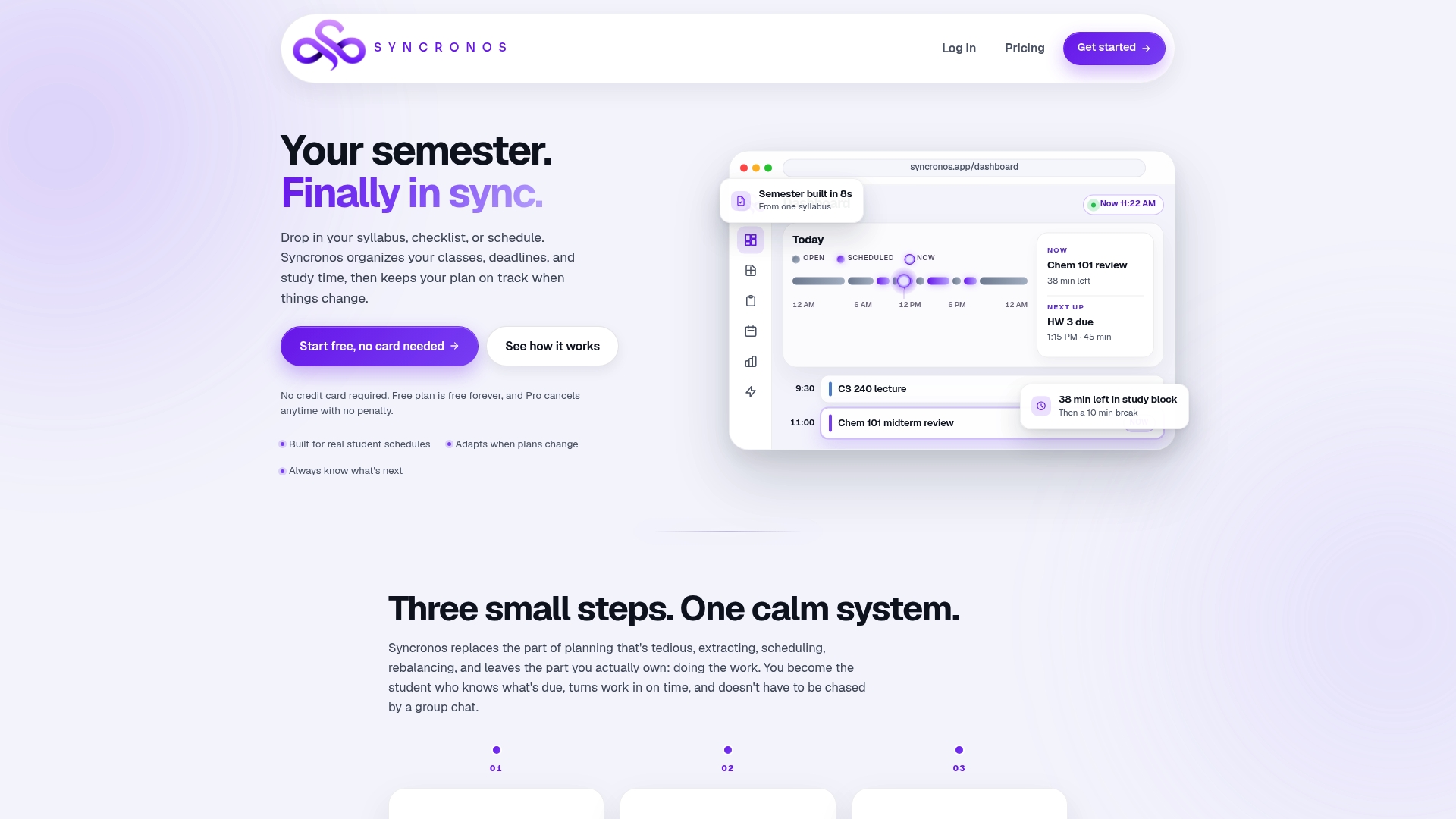
A few ways students use it as part of a prevention routine:
- Upload a syllabus and let the syllabus-to-calendar tool build the term's schedule automatically.
- Use workload forecasting to spot a heavy week before it arrives, not after.
- Set protected rest blocks once and let rebalancing rules work around them instead of over them.
None of this replaces sleep, movement, or a real conversation with someone you trust. It simply removes some of the manual scheduling that eats into those things. You can try the free tier or check the Syncronos pricing page for subscription plans to unlock full adaptive scheduling.
Selected authoritative research and guidance
- Academic Burnout Reduction Handbook (UCL-led, 2025)
- The Effectiveness of a Stress Reduction and Burnout Prevention Program (PMC)
- Physical activity and academic burnout, Frontiers in Psychology (2026)
- Structured recovery protocol for study burnout, NetMock (2026)
- Preventing Burnout: A Guide to Protecting Your Well-Being, APA (2025)
This article is general information, not a substitute for advice from a qualified doctor. Consult a qualified healthcare professional about your own circumstances before acting on anything here.
Sources
- Academic Burnout Reduction Handbook (UCL-led, 2025)
- The Effectiveness of a Stress Reduction and Burnout Prevention Program — PMC
FAQ
What is the 14-day rule for burnout recovery?
It refers to a structured recovery protocol built around three phases: a full stop with sleep as the priority, a gradual reintroduction of light social activity, and a graded return to studying using process metrics rather than grades. Recovery guidance following this model reports that many students see improvement within two to four weeks.
How can I prevent burnout while studying?
Protect a consistent sleep schedule, move your body regularly, keep at least one reliable social connection, and treat a weekly off-day as non-negotiable rather than optional. These practices form the core of multi-level prevention approaches recommended in academic burnout research.
What are the core components of burnout?
Burnout is generally described through three components: persistent exhaustion, growing cynicism or detachment toward the work, and a decline in perceived effectiveness. Some frameworks add related dimensions like perfectionism or communication breakdowns, though definitions vary across sources.
How do I know if I need professional help for burnout?
Seek help if exhaustion or loss of motivation starts interfering with daily functioning, if insomnia persists despite consistent sleep habits, or if you experience thoughts of self-harm. Clinical guidance on student burnout recommends involving a counselor or physician early rather than waiting for symptoms to worsen.
Can exercise really reduce study burnout?
Regular physical activity has been shown to moderate the relationship between academic stress and burnout, meaning students who exercise consistently tend to show lower burnout levels even under similar stress. A 2026 study in Frontiers in Psychology found this effect held even when accounting for problematic screen use.