
Run 2 to 4 focused sessions of 60 to 120 minutes across your weekend, prioritize no more than three goals, and treat sleep as part of the plan, not an afterthought. That structure works whether you have four hours free or twelve. The sample schedules below give you a starting template for each scenario, ready to adapt to your own classes and deadlines.
TL;DR:
- Most students should plan for two to four study sessions of 60 to 120 minutes, prioritized by deadlines, high-point tasks, and weak subjects.
- Longer blocks of up to three hours are reserved for intensive STEM work or exam prep, while lighter workloads require minimal weekend study.
- Incorporating strategic breaks, at least 7 to 8 hours of sleep, and active recall sessions on Sunday significantly improves retention and reduces burnout.
- Using AI tools like Syncronos can automate syllabus extraction and schedule rebalancing when deadlines change, saving planning time.
- Study hours generally depend on credit load, with a typical guideline of 2 to 3 hours per credit per week, adjusted based on ongoing coursework and upcoming assessments.
Table of Contents
- Weekend Study Schedule Examples for Every Workload
- How Do I Build My Own Weekend Study Schedule?
- Why Do Breaks and Sleep Matter More Than Extra Hours?
- How Syncronos Turns Your Syllabus Into Weekend Blocks
- Why Consistency Beats Cramming
- Automate Your Weekend Study Blocks
- Sources
- FAQ
Weekend Study Schedule Examples for Every Workload
The right template depends on how much is actually due, not how guilty you feel about your free time. Pick the one that matches your real week, not the one that sounds most productive.
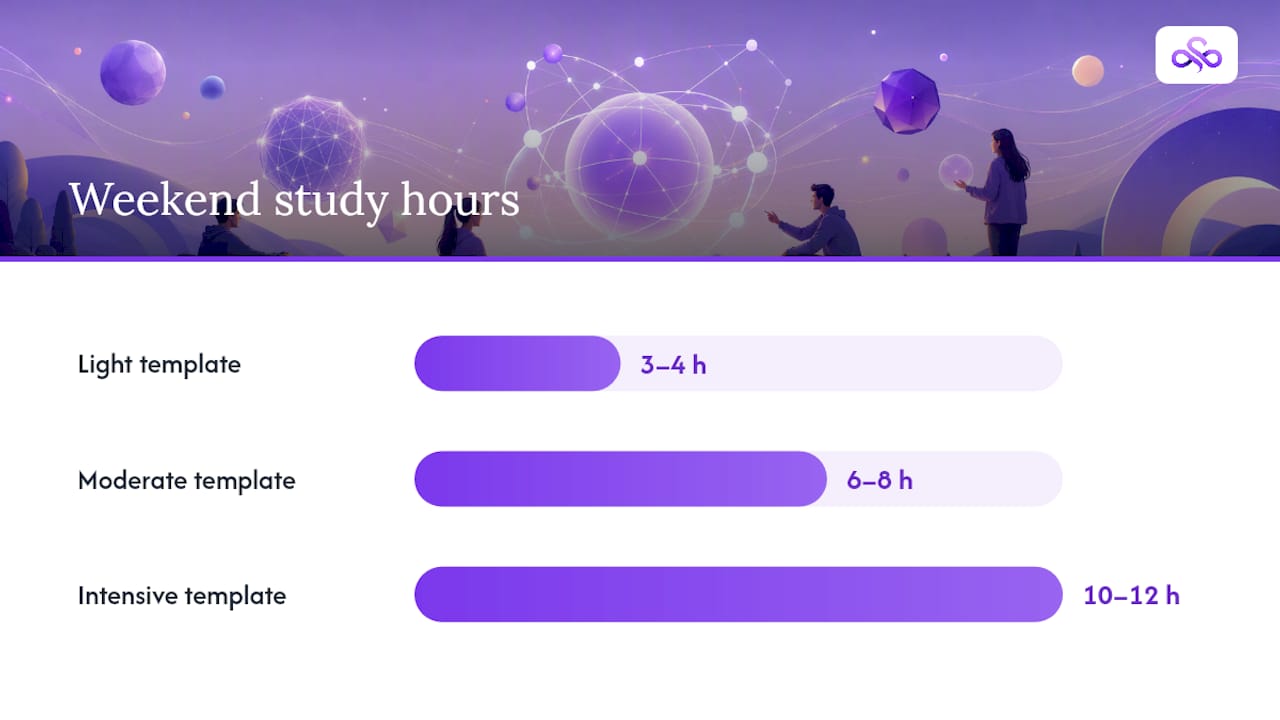
Light template (3 to 4 hours total)
This fits a weekend where nothing is due Monday, but you want to stay current.
- Saturday: one 90 minute block, late morning. Review class notes, redo one problem set, flag anything confusing.
- Sunday: one 60 to 90 minute block, early evening. Flashcards or a quick self-quiz on the week's material.
- Best for: steady-state weeks, or students protecting rest after a heavy week.
Moderate template (6 to 8 hours total)
This is the workhorse schedule for regular assignment load and ongoing midterm prep.
- Saturday morning (9:00 to 11:00 AM): deep work on the hardest subject, one 90 minute block plus a 15 minute break split inside it.
- Saturday afternoon (1:00 to 3:00 PM): assignment work or a problem set, second subject.
- Sunday morning (10:00 to 11:30 AM): practice test or applied problems.
- Sunday afternoon (4:00 to 5:00 PM): active recall, flashcards, review of Saturday's wrong answers.
This lines up with the 3-2-1 block framework many graduate students use: three hours of deep work, two hours of administrative tasks like reading and organizing, one hour of review. Splitting cognitive load this way keeps Saturday from turning into a marathon.
Intensive template (10 to 12 hours total)
Reserve this for exam weeks only. It is not sustainable as a weekly habit.
- Saturday 9:00 AM to 12:00 PM: longest deep-work block, hardest exam subject, with a real 30 minute break at the midpoint.
- Saturday 1:30 to 4:30 PM: second subject or applied practice problems.
- Saturday evening: off. No exceptions.
- Sunday 10:00 AM to 1:00 PM: practice test under timed conditions.
- Sunday 3:00 to 5:00 PM: active recall and wrong-answer review.
- Sunday evening: closed. Protect it for sleep prep and a genuine break.
Loading Saturday heavier than Sunday follows a 60/40 or 70/30 weekend split that leaves Sunday lighter for recall and planning instead of new material.
How Do I Build My Own Weekend Study Schedule?
Copying a template only gets you so far. Building your own starts with a number: how many hours do you actually need this weekend?
- Calculate your weekend gap. A common rule multiplies credit hours by 2 to 3 hours of study per credit per week. Subtract the hours you already logged Monday through Friday. Whatever is left is your weekend target.
- Pick session count and length. Two to four sessions of 60 to 120 minutes each covers most workloads. Reserve longer blocks, up to three hours, for calculation-heavy STEM work that needs uninterrupted flow.
- Prioritize in this order: deadlines first, then high-point-value tasks, then your weakest subject. Apply the 80/20 rule here. Twenty percent of your material is usually causing eighty percent of your stress. Find it and put it first.
- Sequence for energy, not convenience. Put your hardest subject in the first block, when your focus is freshest. This mirrors the way many students assign morning blocks to their toughest coursework rather than saving it for a tired Sunday.
- Interleave subjects instead of marathoning one. Switching between related topics within a session improves long-term retention more than grinding a single subject for four straight hours.
- Assign Sunday's last block to active recall. Practice tests, flashcards, or a wrong-answer log from Saturday's work.
Before you finalize anything, run through a short checklist: What's actually due this week? Is there a test on the calendar? What's your real energy level Saturday versus Sunday? What's must-do versus nice-to-do?
Pro Tip: Write your three priorities on a sticky note before you open a single textbook. If a task isn't one of the three, it doesn't get a weekend block, it gets a weekday slot instead.
Why Do Breaks and Sleep Matter More Than Extra Hours?
Cornell's Learning Strategies Center is direct about this: a study schedule needs balanced activities, including planned breaks, sleep, and exercise, not just more hours stacked on top of each other. Skipping sleep to add a fifth session usually costs you more than it gives back.
Two break structures work for different tasks:
- Pomodoro (25 minutes work, 5 minutes rest): best for administrative tasks, reading, or anything low on cognitive load where momentum matters more than depth.
- 90 minute ultradian blocks with 15 to 30 minute breaks: better suited to deep work like problem sets, essay drafting, or dense reading, where switching costs are high and you need real recovery time between blocks.
Cornell recommends 7 to 8 hours of sleep a night for memory consolidation, and points to physical activity as a direct support for cognitive control, not just a nice-to-have. Dartmouth's academic skills team adds a practical layer: turning off your phone during sessions and even gamifying study with small rewards measurably improves focus and follow-through.
Sunday's active-recall block should include a practice test, a flashcard run, and a wrong-answer log pulled from anything you missed Saturday. That combination reduces the snowball effect of falling behind, since you catch gaps before Monday rather than during the next exam. Close Sunday with a deliberate power-down window, several hours with zero academic work, to protect Monday's readiness.
How Syncronos Turns Your Syllabus Into Weekend Blocks
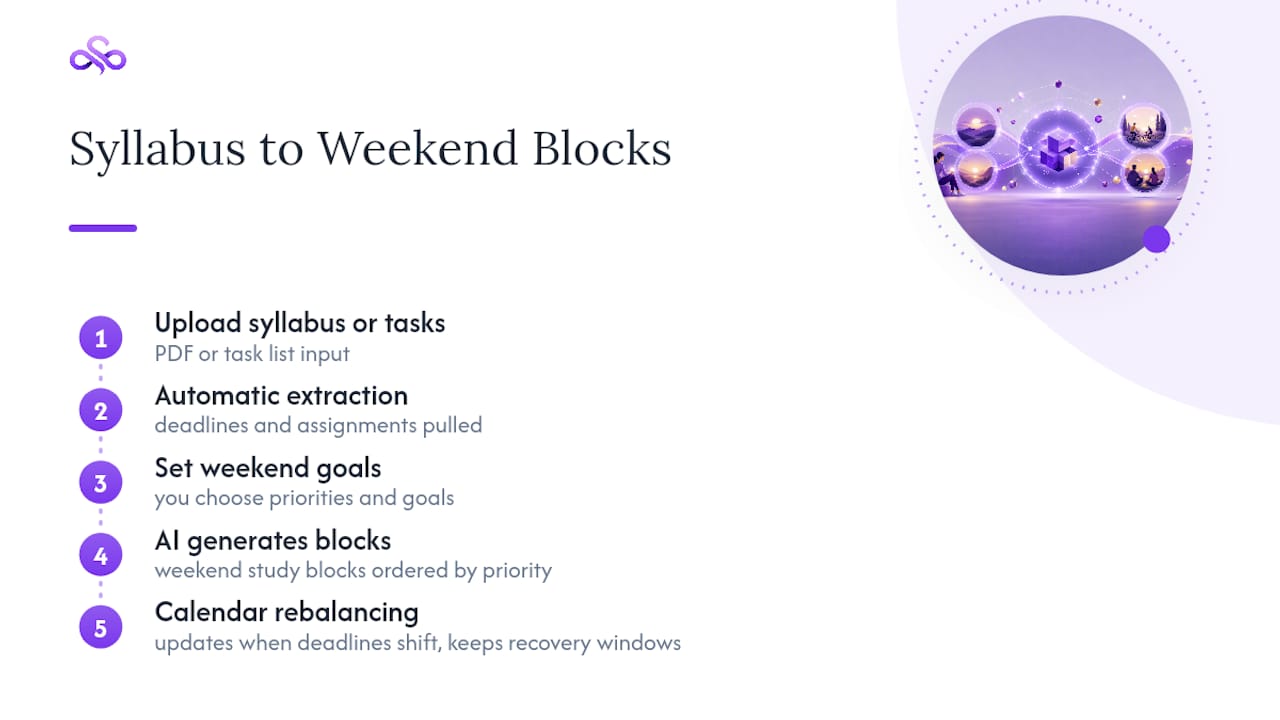
Building the schedule above manually takes real time: pulling deadlines from three syllabi, checking point values, then blocking your calendar around them. Syncronos automates that first step. Upload your syllabus or task list, and it extracts deadlines and assignments automatically. From there you set your weekend goals, and the AI study planner generates weekend blocks around them, ordered by priority.
When a deadline shifts or a new assignment lands midweek, the calendar is rebalanced instead of requiring you to redo it by hand. The result is a prioritized weekend view built from your actual coursework, with recovery windows kept intact rather than quietly erased by a new due date. The syllabus-to-calendar feature handles the extraction step specifically, turning a PDF syllabus into calendar entries without manual retyping.
Why Consistency Beats Cramming
Heroic all-nighters make for good stories, not good grades. A weekend schedule you can actually repeat, protecting sleep, rotating subjects, closing Sunday night, builds retention slowly and predictably. Test one template for three or four weekends before you decide it needs changing.
— Syncronos
Automate Your Weekend Study Blocks
An AI-powered planner can give you back the planning time a manual weekend schedule usually eats up. Instead of retyping deadlines from multiple syllabi into a calendar app, you upload them once and the system extracts the tasks, due dates, and point values automatically.
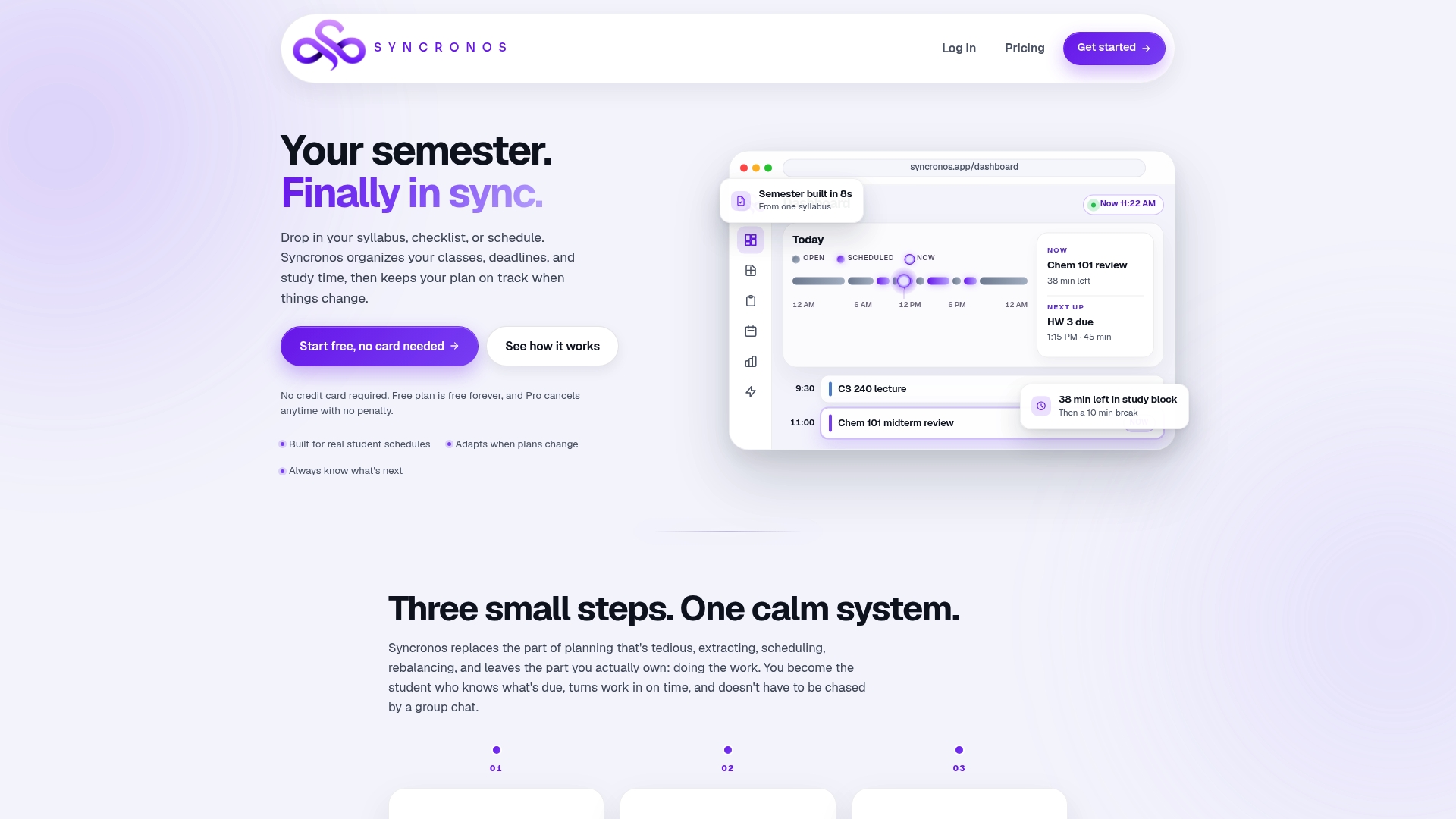
From there, the assignment planner helps you rank tasks by deadline and weight, so your weekend blocks reflect what actually matters this week, not just what feels urgent. When a professor moves an exam date or adds a new problem set, Syncronos rebalances your existing blocks instead of leaving you to rebuild the whole weekend from scratch. If you want a workflow built specifically around exam weeks, the exam study planner applies the same logic to intensive prep windows. Start by uploading one syllabus at Syncronos and see your first weekend schedule generated in minutes.
Sources
- Guidelines for Creating a Study Schedule – Learning Strategies Center, Cornell University
- Studying On The Weekend – Academic Skills Center Blog, Dartmouth College
- Maximize your Saturday: A simple guide to planning study hours – StudyCards AI
- Effective Weekend Study Habits for Master’s Students – DegreeFromAnywhere
For students juggling motivation and screen time alongside coursework, AI productivity strategies for students covers additional tactics worth pairing with a weekend routine. Premed and clinical-track students managing rotation hours alongside coursework may also find the premed planning tools at MedSchoolPilot useful for tracking overlapping commitments.
FAQ
What is a good weekend study routine?
A good routine runs 2 to 4 sessions of 60 to 120 minutes across Saturday and Sunday, front loads your hardest subject, and reserves Sunday for active recall and planning next week.
What is the 1/3, 5/7 rule in studying?
This isn't a standard, widely documented study framework, and definitions of it vary informally online, so treat any specific version you encounter with caution rather than as an established rule.
Is it okay to study on weekends?
Yes, and for most students it is necessary. The key is balance: pair weekend study blocks with 7 to 8 hours of sleep and real breaks, following Cornell's guidance on balanced study schedules, rather than treating the weekend as one long uninterrupted session.
What is the 9-8-7 rule for studying?
This isn't a standard, documented study framework either. If you've seen it referenced somewhere, it's likely an informal shorthand rather than a research-backed method, so it's worth verifying the source before applying it.
How many hours should I study on a weekend?
It depends on your credit load and deadlines. A common estimate multiplies credit hours by 2 to 3 hours per credit per week, then subtracts hours already logged during the week to find your weekend target.